Ch. 11 - Properties and Synthesis of Alkyl Halides: Radical Reactions
Mullins - Organic Chemistry: A Learner Centered Approach 1st Edition
Mullins1st EditionOrganic Chemistry: A Learner Centered ApproachISBN: 9780137566471Non è quello che usi tu?Cambia libro di testo
Capitolo 10, Problema 63b

Predict the product of the following benzylic bromination reactions.
(b) Chemical reaction diagram: benzylic bromination of ethylbenzene with Br2 and heat, showing reactant structure.

Guida verificata passo dopo passo
1
Identify the type of reaction: This is a benzylic bromination reaction, which typically involves the substitution of a hydrogen atom at the benzylic position with a bromine atom.
Locate the benzylic position: The benzylic position is the carbon atom directly attached to the benzene ring. In this reaction, identify the carbon atom that is adjacent to the benzene ring.
Consider the mechanism: Benzylic bromination usually proceeds via a radical mechanism. The presence of a radical initiator, such as N-bromosuccinimide (NBS), facilitates the formation of a benzylic radical.
Predict the formation of the benzylic radical: The hydrogen atom at the benzylic position is abstracted, forming a benzylic radical. This radical is stabilized by resonance with the benzene ring.
Determine the final product: The benzylic radical reacts with bromine to form the brominated product. The bromine atom replaces the hydrogen atom at the benzylic position, resulting in the formation of the benzylic bromide.

Risposta video verificata per un problema simile:

Questa soluzione video è stata consigliata dai nostri tutor come utile per risolvere questo problema.
Durata del video:
3m

Concetti chiave

Ecco i concetti essenziali che devi comprendere per rispondere correttamente alla domanda.

Benzylic Bromination

Benzylic bromination is a type of radical halogenation reaction where a bromine atom is introduced at the benzylic position, which is the carbon atom directly attached to a benzene ring. This reaction typically involves the use of N-bromosuccinimide (NBS) and a radical initiator, such as light or heat, to generate bromine radicals that selectively react with the benzylic hydrogen atoms.
Video consigliato:
00:54
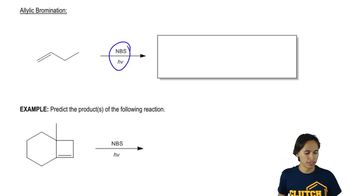
Mechanism of Allylic Bromination.

Radical Mechanism

Radical mechanisms involve the formation and reaction of radicals, which are species with unpaired electrons. In benzylic bromination, the reaction proceeds through a radical chain mechanism, starting with the generation of bromine radicals, followed by hydrogen abstraction from the benzylic position, and finally, the formation of the brominated product. Understanding the stability and reactivity of radicals is crucial for predicting the outcome of such reactions.
Video consigliato:
03:28
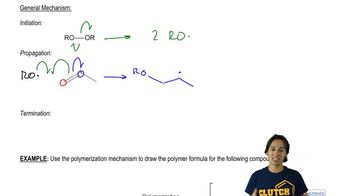
The mechanism of Radical Polymerization.

Benzylic Position Stability

The benzylic position is highly reactive due to the stability of the benzylic radical formed during the reaction. This stability arises from resonance, where the unpaired electron can be delocalized over the aromatic ring, making the benzylic radical more stable than other alkyl radicals. This enhanced stability is a key factor in the selectivity of benzylic bromination reactions, as it favors the formation of products at the benzylic position.
Video consigliato:
Percorso guidato
2:46
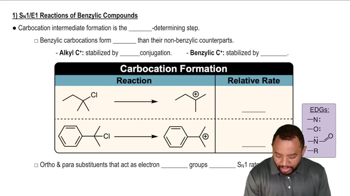
Reactions at Benzylic Positions Concept 2