Ch. 11 - Properties and Synthesis of Alkyl Halides: Radical Reactions
Mullins - Organic Chemistry: A Learner Centered Approach 1st Edition
Mullins1st EditionOrganic Chemistry: A Learner Centered ApproachISBN: 9780137566471Non è quello che usi tu?Cambia libro di testo
Capitolo 10, Problema 8a

From the IUPAC name, draw the corresponding structure.
(a) (R)-6-iodo-3-isopropylnon-1-ene

Guida verificata passo dopo passo
1
Step 1: Break down the IUPAC name systematically. The name '(R)-6-iodo-3-isopropylnon-1-ene' indicates a molecule with a nonane backbone (9 carbon atoms) and specific substituents and stereochemistry.
Step 2: Identify the main chain. The 'non-1-ene' part specifies a 9-carbon chain with a double bond at the first carbon. Draw a straight chain of 9 carbons and place a double bond between C1 and C2.
Step 3: Add the substituents. The '6-iodo' indicates an iodine atom attached to the 6th carbon, and '3-isopropyl' indicates an isopropyl group attached to the 3rd carbon. Place these substituents accordingly on the main chain.
Step 4: Incorporate stereochemistry. The '(R)' designation specifies the absolute configuration at the chiral center. Determine the chiral center (C3, where the isopropyl group is attached) and assign the (R) configuration based on the Cahn-Ingold-Prelog priority rules.
Step 5: Verify the structure. Ensure the double bond, substituents, and stereochemistry are correctly placed and consistent with the IUPAC name. Double-check the connectivity and spatial arrangement of atoms.

Risposta video verificata per un problema simile:

Questa soluzione video è stata consigliata dai nostri tutor come utile per risolvere questo problema.
Durata del video:
7m

Concetti chiave

Ecco i concetti essenziali che devi comprendere per rispondere correttamente alla domanda.

IUPAC Nomenclature

IUPAC nomenclature is a systematic method for naming organic chemical compounds. It provides a unique name that conveys the structure of the molecule, including the type of functional groups, the length of the carbon chain, and the position of substituents. Understanding IUPAC rules is essential for translating names into chemical structures.
Video consigliato:
03:43
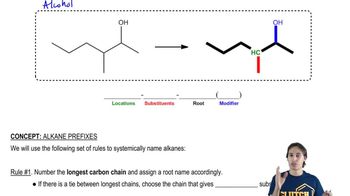
The different parts of an IUPAC name

Stereochemistry

Stereochemistry refers to the study of the spatial arrangement of atoms in molecules and how this affects their chemical behavior. The designation (R) in the name indicates a specific three-dimensional configuration around a chiral center, which is crucial for accurately drawing the structure. Recognizing stereochemical descriptors is vital for understanding isomerism in organic compounds.
Video consigliato:
Percorso guidato
1:38
Polymer Stereochemistry Concept 1

Alkenes and Substituents

Alkenes are hydrocarbons that contain at least one carbon-carbon double bond, which influences their reactivity and physical properties. The name '3-isopropylnon-1-ene' indicates the presence of an isopropyl group as a substituent on the nonene backbone. Familiarity with the structure and behavior of alkenes and their substituents is necessary for constructing the correct molecular structure.
Video consigliato:
Percorso guidato
2:09
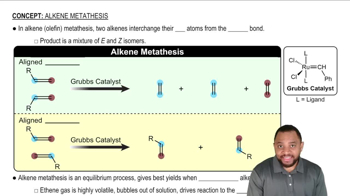
Alkene Metathesis Concept 1