Ch. 11 - Properties and Synthesis of Alkyl Halides: Radical Reactions
Mullins - Organic Chemistry: A Learner Centered Approach 1st Edition
Mullins1st EditionOrganic Chemistry: A Learner Centered ApproachISBN: 9780137566471Non è quello che usi tu?Cambia libro di testo
Capitolo 10, Problema 22c

Predict the major products of the following alkane halogenation reactions. [The number of products shown ignores the formation of racemic mixtures.]
(c)

Guida verificata passo dopo passo
1
Identify the type of reaction: This is a free radical halogenation reaction involving chlorine (Cl₂) and heat, which typically leads to the substitution of hydrogen atoms in alkanes with chlorine atoms.
Analyze the structure of the alkane: The given alkane is 2-methylbutane, which has primary, secondary, and tertiary hydrogen atoms available for substitution.
Determine the reactivity of hydrogen atoms: In free radical halogenation, tertiary hydrogens are the most reactive, followed by secondary, and then primary hydrogens. This is due to the stability of the resulting free radicals.
Predict the major products: The reaction will likely produce three different chlorinated products based on the substitution at different hydrogen sites. Consider the formation of products from the substitution at tertiary, secondary, and primary positions.
Consider the number of products: Since the problem specifies three products, focus on the most likely sites for chlorine substitution that would lead to distinct products, ignoring any racemic mixtures that might form.

Risposta video verificata per un problema simile:

Questa soluzione video è stata consigliata dai nostri tutor come utile per risolvere questo problema.
Durata del video:
2m

Concetti chiave

Ecco i concetti essenziali che devi comprendere per rispondere correttamente alla domanda.

Alkane Halogenation

Alkane halogenation is a substitution reaction where an alkane reacts with a halogen (like Cl2 or Br2) to form alkyl halides. This process typically involves the generation of free radicals through the homolytic cleavage of the halogen bond, followed by a series of radical propagation steps that lead to the substitution of hydrogen atoms in the alkane with halogen atoms.
Video consigliato:
02:47
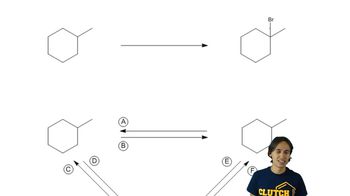
Functionalizing Alkanes

Free Radical Mechanism

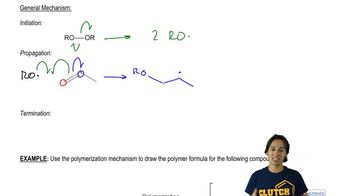
The free radical mechanism is a multi-step process that includes initiation, propagation, and termination steps. In the initiation step, halogen molecules dissociate into free radicals. During propagation, these radicals react with alkanes to form new radicals and alkyl halides. The process continues until termination occurs, where two radicals combine to form a stable product, effectively ending the reaction.
Video consigliato:
03:28
The mechanism of Radical Polymerization.

Regioselectivity

Regioselectivity refers to the preference of a chemical reaction to yield one structural isomer over others when multiple products are possible. In alkane halogenation, the formation of products is influenced by the stability of the resulting radicals; more stable tertiary radicals are favored over primary ones, leading to a higher yield of products derived from more substituted carbon centers.
Video consigliato:
05:09
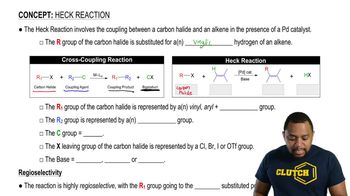
Heck Reaction