Ch. 11 - Properties and Synthesis of Alkyl Halides: Radical Reactions
Mullins - Organic Chemistry: A Learner Centered Approach 1st Edition
Mullins1st EditionOrganic Chemistry: A Learner Centered ApproachISBN: 9780137566471Non è quello che usi tu?Cambia libro di testo
Capitolo 10, Problema 10a

Predict the product of the following haloalkane syntheses.
(a)

Guida verificata passo dopo passo
1
Step 1: Analyze the given molecule, which is a cyclohexene derivative with a double bond. The reactions provided involve halogenation and hydrohalogenation, which target the double bond.
Step 2: For reaction (a) with Br₂, the double bond undergoes electrophilic addition. Bromine adds across the double bond, forming a vicinal dibromide. The stereochemistry of the product depends on anti-addition due to the bromonium ion intermediate.
Step 3: For reaction (b) with HBr, the double bond undergoes hydrohalogenation. According to Markovnikov's rule, the bromine atom will add to the more substituted carbon of the double bond, forming a bromoalkane.
Step 4: For reaction (c) with HBr and H₂O₂, the reaction follows anti-Markovnikov addition due to the presence of peroxides. Bromine adds to the less substituted carbon of the double bond, forming a bromoalkane.
Step 5: For reaction (d) with Cl₂, the double bond undergoes electrophilic addition similar to reaction (a). Chlorine adds across the double bond, forming a vicinal dichloride with anti-addition stereochemistry.

Risposta video verificata per un problema simile:

Questa soluzione video è stata consigliata dai nostri tutor come utile per risolvere questo problema.
Durata del video:
3m

Concetti chiave

Ecco i concetti essenziali che devi comprendere per rispondere correttamente alla domanda.

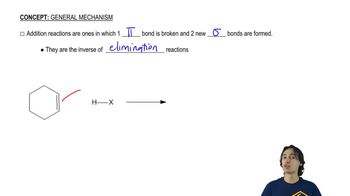
Electrophilic Addition Reactions

Electrophilic addition reactions are a fundamental type of reaction in organic chemistry where an electrophile reacts with a nucleophile, typically involving alkenes or alkynes. In the context of haloalkanes, these reactions often lead to the formation of haloalkanes from alkenes by adding halogens or hydrogen halides across the double bond.
Video consigliato:
05:39
Features of Addition Mechanisms.

Regioselectivity

Regioselectivity refers to the preference of a chemical reaction to yield one structural isomer over others when multiple products are possible. In the case of haloalkane syntheses, the regioselectivity can be influenced by the stability of the carbocation intermediate formed during the reaction, which determines the major product.
Video consigliato:
05:09
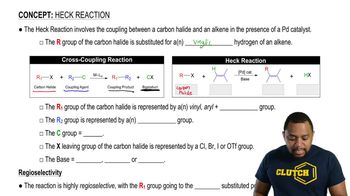
Heck Reaction

Mechanism of Halogenation

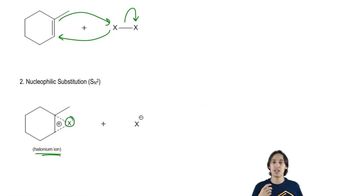
The mechanism of halogenation involves the addition of halogens (like Br2 or Cl2) to alkenes, resulting in the formation of vicinal dihalides. This process typically proceeds through a cyclic halonium ion intermediate, which is crucial for understanding the stereochemistry and regioselectivity of the products formed in the reaction.
Video consigliato:
03:45
Halogenation Mechanism