Ch. 11 - Properties and Synthesis of Alkyl Halides: Radical Reactions
Mullins - Organic Chemistry: A Learner Centered Approach 1st Edition
Mullins1st EditionOrganic Chemistry: A Learner Centered ApproachISBN: 9780137566471Non è quello che usi tu?Cambia libro di testo
Capitolo 10, Problema 3

Using the bond-dissociation energies in Table 5.6 (see Section 5.3.1), estimate the equilibrium constant of the following reaction at 298 K.

Guida verificata passo dopo passo
1
Step 1: Identify the bonds broken and formed in the reaction. In the reactants, the bonds broken are one Cl-Cl bond and one C-H bond in the alkene. In the products, the bonds formed are one C-Cl bond and one H-Cl bond.
Step 2: Use the bond-dissociation energies (BDEs) from Table 5.6 to calculate the energy change for the reaction. The energy change is calculated as the sum of the BDEs of bonds broken minus the sum of the BDEs of bonds formed. Represent this calculation as ΔH = Σ(BDE_broken) - Σ(BDE_formed).
Step 3: Relate the enthalpy change (ΔH) to the equilibrium constant (K) using the Gibbs free energy equation: ΔG = ΔH - TΔS. Assume ΔS (entropy change) is negligible if not provided, and approximate ΔG ≈ ΔH at 298 K.
Step 4: Use the relationship between Gibbs free energy and the equilibrium constant: ΔG = -RT ln(K), where R is the gas constant (8.314 J/mol·K) and T is the temperature in Kelvin (298 K). Rearrange to solve for K: K = e^(-ΔG/RT).
Step 5: Substitute the calculated ΔH value into the equation for ΔG and then into the equation for K. This will provide the equilibrium constant for the reaction at 298 K.

Risposta video verificata per un problema simile:

Questa soluzione video è stata consigliata dai nostri tutor come utile per risolvere questo problema.

Concetti chiave

Ecco i concetti essenziali che devi comprendere per rispondere correttamente alla domanda.

Bond Dissociation Energy

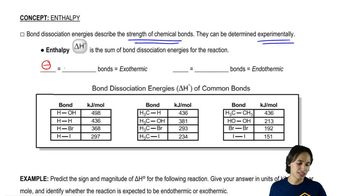
Bond dissociation energy (BDE) is the energy required to break a specific bond in a molecule, resulting in the formation of two radicals. It is a crucial concept in thermodynamics and kinetics, as it helps predict the stability of molecules and the feasibility of chemical reactions. Higher BDE values indicate stronger bonds, which can influence the equilibrium position of a reaction.
Video consigliato:
04:09
How to calculate enthalpy using bond dissociation energies.

Equilibrium Constant (K)

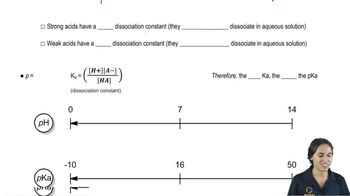
The equilibrium constant (K) is a numerical value that expresses the ratio of the concentrations of products to reactants at equilibrium for a given reaction at a specific temperature. It provides insight into the extent of a reaction and whether it favors products or reactants. The equilibrium constant can be calculated using the standard Gibbs free energy change or through bond dissociation energies.
Video consigliato:
02:19
The relationship between equilibrium constant and pKa.

Thermodynamic Relationships

Thermodynamic relationships, particularly the connection between bond energies and Gibbs free energy, are essential for estimating equilibrium constants. The change in Gibbs free energy (ΔG) for a reaction can be derived from the difference in bond dissociation energies of the reactants and products. Understanding these relationships allows chemists to predict reaction spontaneity and equilibrium positions.
Video consigliato:
08:51
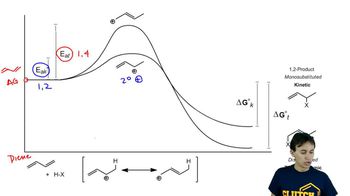
Kinetic vs. Thermodynamic Control