Ch. 12 - Substitution and Elimination: Reactions of Haloalkanes
Mullins - Organic Chemistry: A Learner Centered Approach 1st Edition
Mullins1st EditionOrganic Chemistry: A Learner Centered ApproachISBN: 9780137566471Non è quello che usi tu?Cambia libro di testo
Capitolo 11, Problema 41d

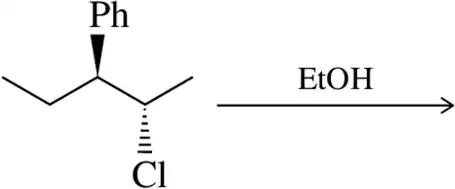
Given the reactants shown, what type of elimination would you expect to occur?
(d) Chemical structure showing a phenyl group, a chlorine atom, and ethanol as a reactant for elimination reaction analysis.

Guida verificata passo dopo passo
1
Identify the type of substrate (primary, secondary, or tertiary alkyl halide) involved in the reaction. This is crucial because the structure of the substrate influences the type of elimination mechanism (E1 or E2).
Examine the strength and type of the base used in the reaction. A strong base typically favors the E2 mechanism, while a weak base or neutral conditions may favor the E1 mechanism.
Consider the reaction conditions, such as the solvent. Polar protic solvents (e.g., water, alcohols) tend to stabilize carbocations and favor the E1 mechanism, while polar aprotic solvents (e.g., DMSO, acetone) are more conducive to the E2 mechanism.
Analyze the possibility of carbocation stability. If the substrate can form a stable carbocation (e.g., tertiary or resonance-stabilized carbocation), the E1 mechanism is more likely. If the substrate is less likely to form a stable carbocation, the E2 mechanism is favored.
Determine the stereochemical requirements of the elimination. The E2 mechanism requires a specific anti-periplanar geometry between the leaving group and the β-hydrogen, while the E1 mechanism does not have such a strict stereochemical requirement.

Risposta video verificata per un problema simile:

Questa soluzione video è stata consigliata dai nostri tutor come utile per risolvere questo problema.
Durata del video:
2m

Concetti chiave

Ecco i concetti essenziali che devi comprendere per rispondere correttamente alla domanda.

Elimination Reactions

Elimination reactions are a type of organic reaction where two substituents are removed from a molecule, resulting in the formation of a double bond or a ring structure. These reactions are crucial in organic synthesis and can be classified into two main types: E1 and E2, which differ in their mechanisms and conditions.
Video consigliato:
00:40
Recognizing Elimination Reactions.

E1 vs. E2 Mechanisms

The E1 mechanism involves a two-step process where the leaving group departs first, forming a carbocation intermediate, followed by deprotonation to form the double bond. In contrast, the E2 mechanism is a one-step process where the base abstracts a proton while the leaving group exits simultaneously, leading to the formation of the double bond without an intermediate.
Video consigliato:
09:36
Drawing the E2 Mechanism.

Regioselectivity and Stereoselectivity

Regioselectivity refers to the preference of a chemical reaction to yield one structural isomer over others, while stereoselectivity indicates the preference for one stereoisomer in the product. Understanding these concepts is essential in predicting the outcome of elimination reactions, as they influence the final structure of the product formed from the reactants.
Video consigliato:
05:09
Heck Reaction