Ch. 12 - Substitution and Elimination: Reactions of Haloalkanes
Mullins - Organic Chemistry: A Learner Centered Approach 1st Edition
Mullins1st EditionOrganic Chemistry: A Learner Centered ApproachISBN: 9780137566471Non è quello che usi tu?Cambia libro di testo
Capitolo 11, Problema 21e

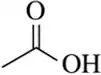
Identify the following solvents as polar protic, polar aprotic, or nonpolar.
(e) Chemical structure of acetic acid, featuring a carbon atom bonded to a hydroxyl group and a carbonyl group.

Guida verificata passo dopo passo
1
Step 1: Understand the definitions of polar protic, polar aprotic, and nonpolar solvents. Polar protic solvents have a hydrogen atom attached to an electronegative atom (like O or N), allowing them to form hydrogen bonds. Polar aprotic solvents are polar but lack hydrogen atoms bonded to electronegative atoms, so they cannot form hydrogen bonds. Nonpolar solvents have little to no polarity and do not dissolve ionic compounds well.
Step 2: Examine the molecular structure of the solvent in question. Look for functional groups or atoms that indicate polarity (e.g., electronegative atoms like O, N, or halogens) and the presence of hydrogen atoms bonded to these electronegative atoms.
Step 3: Determine if the solvent can form hydrogen bonds. If it has hydrogen atoms bonded to electronegative atoms, it is polar protic. If it lacks such hydrogen atoms but is still polar, it is polar aprotic. If it lacks significant polarity, it is nonpolar.
Step 4: Consider the solvent's dielectric constant and dipole moment. Polar solvents generally have high dielectric constants and dipole moments, while nonpolar solvents have low values for these properties.
Step 5: Categorize the solvent based on the observations from the previous steps. Use the definitions and characteristics to classify the solvent as polar protic, polar aprotic, or nonpolar.

Risposta video verificata per un problema simile:

Questa soluzione video è stata consigliata dai nostri tutor come utile per risolvere questo problema.
Durata del video:
3m

Concetti chiave

Ecco i concetti essenziali che devi comprendere per rispondere correttamente alla domanda.

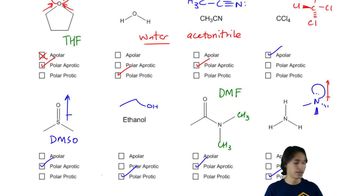
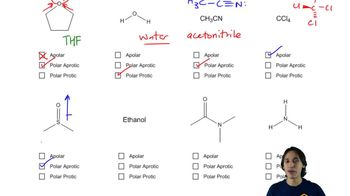
Polar Protic Solvents

Polar protic solvents are characterized by the presence of hydrogen atoms bonded to electronegative atoms, such as oxygen or nitrogen. These solvents can form hydrogen bonds and have a high dielectric constant, which allows them to stabilize ions. Common examples include water, alcohols, and carboxylic acids. Their ability to donate protons makes them effective in facilitating reactions involving nucleophiles.
Video consigliato:
01:19
Identification of polarity in solvents

Polar Aprotic Solvents

Polar aprotic solvents do not have hydrogen atoms bonded to electronegative atoms, which means they cannot form hydrogen bonds. However, they still possess a significant dipole moment, allowing them to dissolve ionic compounds and stabilize cations. Examples include acetone, dimethyl sulfoxide (DMSO), and acetonitrile. These solvents are often used in reactions where strong nucleophiles are involved, as they do not solvate anions as effectively as protic solvents.
Video consigliato:
00:37
Identification of polarity in solvents

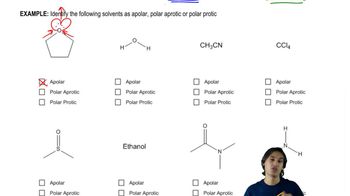
Nonpolar Solvents

Nonpolar solvents are characterized by a lack of significant dipole moments, meaning they do not have regions of positive and negative charge. These solvents are typically composed of hydrocarbons and do not interact favorably with ionic or polar compounds. Common examples include hexane, benzene, and toluene. Nonpolar solvents are often used in reactions involving nonpolar reactants or in extractions where polar compounds need to be separated from nonpolar substances.
Video consigliato:
01:16
Identification of polarity in solvents