Ch. 12 - Substitution and Elimination: Reactions of Haloalkanes
Mullins - Organic Chemistry: A Learner Centered Approach 1st Edition
Mullins1st EditionOrganic Chemistry: A Learner Centered ApproachISBN: 9780137566471Non è quello che usi tu?Cambia libro di testo
Capitolo 11, Problema 47a

Predict the product of the following rearrangement-prone E1 eliminations.
(a) Chemical structure showing a benzene ring with a chlorine atom and deuterium atoms, indicating an E1 elimination reaction with heat.

Guida verificata passo dopo passo
1
Identify the substrate structure and determine if it is prone to rearrangement. Rearrangement typically occurs when a more stable carbocation can form during the E1 mechanism. Look for secondary or tertiary carbocations that can rearrange to a more stable form (e.g., tertiary or resonance-stabilized carbocations).
Understand the E1 mechanism: The first step involves the loss of the leaving group to form a carbocation intermediate. Write the structure of the carbocation formed after the leaving group departs.
Check for possible carbocation rearrangements. This can include hydride shifts (movement of a hydrogen atom with its bonding electrons) or alkyl shifts (movement of an alkyl group with its bonding electrons) to form a more stable carbocation. Draw the rearranged carbocation if applicable.
Once the most stable carbocation is identified, proceed to the elimination step. A base will abstract a β-hydrogen (a hydrogen atom on a carbon adjacent to the carbocation), leading to the formation of a double bond. Identify all possible β-hydrogens and predict the major product based on Zaitsev's rule (the more substituted alkene is usually favored).
Draw the final product(s) of the reaction, ensuring that you account for any rearrangements and the regioselectivity of the elimination step. If multiple products are possible, indicate the major product based on stability and substitution patterns.

Risposta video verificata per un problema simile:

Questa soluzione video è stata consigliata dai nostri tutor come utile per risolvere questo problema.
Durata del video:
4m

Concetti chiave

Ecco i concetti essenziali che devi comprendere per rispondere correttamente alla domanda.

E1 Mechanism

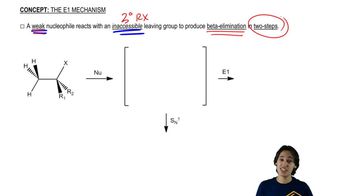
The E1 mechanism is a type of elimination reaction that occurs in two steps: first, the formation of a carbocation intermediate after the leaving group departs, followed by the loss of a proton to form a double bond. This mechanism is favored in polar protic solvents and typically involves tertiary or stabilized carbocations, which can rearrange to more stable forms.
Video consigliato:
08:09
Drawing the E1 Mechanism.

Carbocation Stability

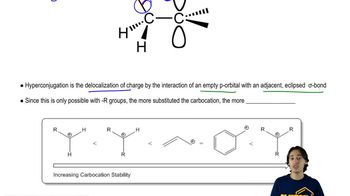
Carbocation stability is crucial in predicting the outcome of E1 reactions. Carbocations are classified as primary, secondary, or tertiary based on the number of alkyl groups attached to the positively charged carbon. Tertiary carbocations are the most stable due to hyperconjugation and inductive effects, making them more likely to form during the reaction.
Video consigliato:
05:58
Determining Carbocation Stability

Rearrangement of Carbocations

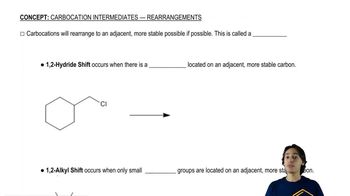
Carbocation rearrangement occurs when a less stable carbocation transforms into a more stable one, often through hydride or alkyl shifts. This process is significant in E1 reactions, as the stability of the final product can be influenced by the rearrangement, leading to different alkene products based on the most stable carbocation formed during the reaction.
Video consigliato:
00:47
Understanding why carbocations shift.