Ch. 12 - Substitution and Elimination: Reactions of Haloalkanes
Mullins - Organic Chemistry: A Learner Centered Approach 1st Edition
Mullins1st EditionOrganic Chemistry: A Learner Centered ApproachISBN: 9780137566471Non è quello che usi tu?Cambia libro di testo
Capitolo 11, Problema 46b

Provide a mechanism for the following E1 reactions.
(b) E1 reaction mechanism showing a cyclohexane structure converting to a product with EtOH.

Guida verificata passo dopo passo
1
Step 1: Identify the reaction type. This is an E1 elimination reaction, which proceeds via a two-step mechanism involving the formation of a carbocation intermediate.
Step 2: Protonation of the leaving group. In the presence of ethanol (EtOH), the iodine atom acts as the leaving group. The bond between the carbon and iodine breaks, forming a carbocation intermediate. The iodine departs as I⁻.
Step 3: Formation of the carbocation intermediate. The carbon attached to the iodine becomes positively charged after the iodine leaves. This carbocation is stabilized by hyperconjugation and inductive effects from the surrounding alkyl groups.
Step 4: Rearrangement of the carbocation (if necessary). In this case, the carbocation is already tertiary and stable, so no rearrangement occurs.
Step 5: Elimination of a proton to form the double bond. A base (ethanol or another molecule in the solution) abstracts a proton from a β-hydrogen (a hydrogen on a carbon adjacent to the carbocation). This results in the formation of a double bond, yielding the alkene product.

Risposta video verificata per un problema simile:

Questa soluzione video è stata consigliata dai nostri tutor come utile per risolvere questo problema.
Durata del video:
3m

Concetti chiave

Ecco i concetti essenziali che devi comprendere per rispondere correttamente alla domanda.

E1 Reaction Mechanism

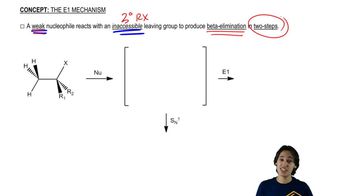
The E1 (unimolecular elimination) reaction mechanism involves two main steps: the formation of a carbocation intermediate followed by the loss of a leaving group to form a double bond. This mechanism typically occurs in polar protic solvents and is characterized by the rate-determining step being the formation of the carbocation, which is influenced by the stability of the carbocation formed.
Video consigliato:
08:09
Drawing the E1 Mechanism.

Carbocation Stability

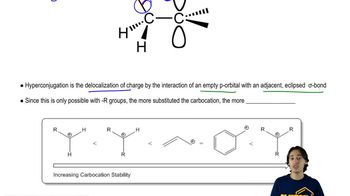
Carbocation stability is crucial in E1 reactions, as more stable carbocations lead to faster reaction rates. Stability is influenced by factors such as the degree of substitution (tertiary > secondary > primary) and resonance effects. In the provided reaction, the formation of a stable carbocation from the cyclohexane structure is essential for the subsequent elimination step to occur efficiently.
Video consigliato:
05:58
Determining Carbocation Stability

Role of Solvent

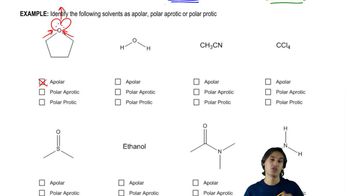
The choice of solvent plays a significant role in E1 reactions. Polar protic solvents, like ethanol (EtOH), stabilize the carbocation intermediate and facilitate the departure of the leaving group. This stabilization lowers the activation energy required for the reaction, making the E1 pathway more favorable compared to other mechanisms, such as E2, which may require a different solvent environment.
Video consigliato:
01:16
Identification of polarity in solvents