Ch. 12 - Substitution and Elimination: Reactions of Haloalkanes
Mullins - Organic Chemistry: A Learner Centered Approach 1st Edition
Mullins1st EditionOrganic Chemistry: A Learner Centered ApproachISBN: 9780137566471Non è quello che usi tu?Cambia libro di testo
Capitolo 11, Problema 32b

Provide a mechanism for the following SN1 reactions that feature a rearrangement.
(b)

Guida verificata passo dopo passo
1
Step 1: Identify the reaction type. This is an SN1 reaction, which proceeds via a two-step mechanism involving the formation of a carbocation intermediate.
Step 2: The first step is the departure of the leaving group (Cl⁻) from the substrate, forming a carbocation. The substrate is benzyl chloride, and the benzyl group stabilizes the carbocation through resonance.
Step 3: Analyze the carbocation intermediate for possible rearrangements. In this case, a hydride shift occurs to form a more stable tertiary carbocation. The hydride shift involves the migration of a hydrogen atom with its bonding electrons from an adjacent carbon to the carbocation center.
Step 4: Once the tertiary carbocation is formed, the nucleophile (acetic acid, CH₃COOH) attacks the carbocation. The oxygen atom in acetic acid donates a lone pair of electrons to form a bond with the carbocation.
Step 5: The final step involves deprotonation of the intermediate formed after nucleophilic attack, resulting in the formation of the product, which is an ester with a phenyl group and a tertiary carbon center.

Risposta video verificata per un problema simile:

Questa soluzione video è stata consigliata dai nostri tutor come utile per risolvere questo problema.

Concetti chiave

Ecco i concetti essenziali che devi comprendere per rispondere correttamente alla domanda.

Sₙ1 Reaction Mechanism

The Sₙ1 (substitution nucleophilic unimolecular) reaction mechanism involves a two-step process where the first step is the formation of a carbocation intermediate after the leaving group departs. This intermediate is then attacked by a nucleophile in the second step. The rate of the reaction depends only on the concentration of the substrate, making it unimolecular.
Video consigliato:
02:16
Heck Reaction Mechanism

Carbocation Stability and Rearrangement

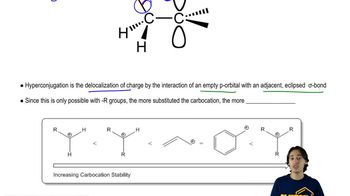
Carbocations are positively charged species that can undergo rearrangement to form more stable structures. Stability increases with the degree of substitution (tertiary > secondary > primary). Rearrangement can occur through hydride or alkyl shifts, allowing the carbocation to transition to a more stable form before the nucleophilic attack.
Video consigliato:
05:58
Determining Carbocation Stability

Nucleophilic Attack

Nucleophilic attack is the process where a nucleophile donates a pair of electrons to an electrophile, forming a new bond. In Sₙ1 reactions, this occurs after the formation of the carbocation. The nucleophile can attack from either side of the planar carbocation, leading to potential stereochemical outcomes, including racemization if the substrate is chiral.
Video consigliato:
08:27
Nucleophilic Addition