The introduction of elimination reactions provides a second way to synthesize alkynes in a two-step process starting with an alkene. Suggest a mechanism for both steps of this process.
Ch. 12 - Substitution and Elimination: Reactions of Haloalkanes

Mullins1st EditionOrganic Chemistry: A Learner Centered ApproachISBN: 9780137566471Non è quello che usi tu?Cambia libro di testo
Tutti i libri di testo
Mullins 1st Edition
Ch. 12 - Substitution and Elimination: Reactions of Haloalkanes
Problema 60b
Mullins 1st Edition
Ch. 12 - Substitution and Elimination: Reactions of Haloalkanes
Problema 60bCapitolo 11, Problema 60b
Suggest a bromoalkane and the conditions necessary to produce the alkenes shown.
(b) 
Guida verificata passo dopo passo1
Analyze the product structure: The product is an alkene with a phenyl group (Ph) attached to the carbon chain. The double bond is located between two carbons in the chain.
Determine the precursor: To form this alkene, a bromoalkane with the bromine atom attached to the carbon adjacent to the double bond in the product is required. This is because elimination reactions typically occur at the β-hydrogen relative to the halogen.
Select the reaction type: The formation of alkenes from bromoalkanes is commonly achieved through an elimination reaction, such as an E2 mechanism. This requires a strong base to abstract a β-hydrogen and promote the elimination of the bromine atom.
Choose the conditions: Use a strong base like potassium tert-butoxide (K⁺[CH₃]₃CO⁻) in a polar aprotic solvent such as dimethyl sulfoxide (DMSO) or ethanol. Heat is often applied to favor elimination over substitution.
Verify regioselectivity: The reaction conditions should favor the formation of the more substituted alkene (Zaitsev's rule), which is the major product in elimination reactions. Ensure the base and solvent are chosen to promote this outcome.

Risposta video verificata per un problema simile:
Questa soluzione video è stata consigliata dai nostri tutor come utile per risolvere questo problema.
Concetti chiave
Ecco i concetti essenziali che devi comprendere per rispondere correttamente alla domanda.
Bromoalkanes
Bromoalkanes are organic compounds containing a bromine atom attached to an alkane chain. They are often used as intermediates in organic synthesis, particularly in reactions that form alkenes through elimination processes. Understanding the structure and reactivity of bromoalkanes is crucial for predicting the products of reactions involving them.
Elimination Reactions
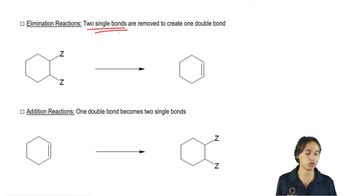
Elimination reactions involve the removal of atoms or groups from a molecule, resulting in the formation of a double bond. In the context of bromoalkanes, these reactions typically occur under conditions such as heating with a strong base, leading to the formation of alkenes. The mechanism can be either E1 or E2, depending on the substrate and conditions.
Video consigliato:
Recognizing Elimination Reactions.
Regioselectivity
Regioselectivity refers to the preference of a chemical reaction to yield one structural isomer over others. In the formation of alkenes from bromoalkanes, the regioselectivity can be influenced by the stability of the resulting double bond and the sterics of the substituents. Understanding regioselectivity is essential for predicting the major products in elimination reactions.
Video consigliato:
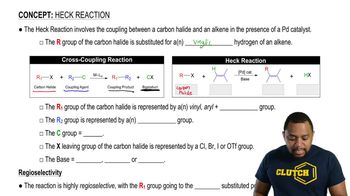
Heck Reaction
Pratica correlata
Domanda del libro di testo
1070
views
Domanda del libro di testo
Suggest a bromoalkane and the conditions necessary to produce the alkenes shown.
(a)
1176
views
Domanda del libro di testo
In Chapter 10, you learned how to make an alkyne by acetylide alkylation with a 1° haloalkane. Suggest a mechanism by which this reaction occurs.
1095
views
Domanda del libro di testo
Acetylide alkylation, from Assessment 12.61, fails to give the desired product with 2° haloalkanes. Why? What is the actual product of this reaction?
1011
views
Domanda del libro di testo
For each pair, choose the haloalkane that would react most quickly in an SN1 or E1 reaction.
(b)
515
views
Domanda del libro di testo
For each pair, choose the haloalkane that would react most quickly in an Sₙ1 or E1 reaction.
(c)
1491
views