Ch. 12 - Substitution and Elimination: Reactions of Haloalkanes
Mullins - Organic Chemistry: A Learner Centered Approach 1st Edition
Mullins1st EditionOrganic Chemistry: A Learner Centered ApproachISBN: 9780137566471Non è quello che usi tu?Cambia libro di testo
Capitolo 11, Problema 63

The introduction of elimination reactions provides a second way to synthesize alkynes in a two-step process starting with an alkene. Suggest a mechanism for both steps of this process.

Guida verificata passo dopo passo
1
Step 1: Analyze the starting material, which is an alkene. The first step involves the addition of bromine (Br₂) to the alkene. This reaction proceeds via an electrophilic addition mechanism, where the π-electrons of the alkene attack the bromine molecule, forming a bromonium ion intermediate.
Step 2: The bromonium ion is then attacked by a bromide ion (Br⁻), leading to the formation of a vicinal dibromide (a molecule with two bromine atoms attached to adjacent carbons). This completes the first step of the process.
Step 3: In the second step, the vicinal dibromide undergoes two consecutive elimination reactions in the presence of a strong base, sodium amide (NaNH₂). The base abstracts a proton from one of the carbons adjacent to a bromine atom, leading to the formation of a double bond and the elimination of a bromide ion.
Step 4: The second equivalent of NaNH₂ then abstracts another proton from the carbon adjacent to the remaining bromine atom, resulting in the formation of a triple bond (alkyne) and the elimination of the second bromide ion.
Step 5: The final product is an alkyne, specifically a terminal alkyne in this case, as the elimination reactions lead to the formation of a triple bond at the end of the carbon chain.

Risposta video verificata per un problema simile:

Questa soluzione video è stata consigliata dai nostri tutor come utile per risolvere questo problema.

Concetti chiave

Ecco i concetti essenziali che devi comprendere per rispondere correttamente alla domanda.

Elimination Reactions

Elimination reactions involve the removal of atoms or groups from a molecule, resulting in the formation of a double or triple bond. In the context of synthesizing alkynes, elimination typically occurs in two steps: first, a halogen is added to an alkene, followed by a dehydrohalogenation step where a base removes a hydrogen halide, leading to the formation of an alkyne.
Video consigliato:
00:40
Recognizing Elimination Reactions.

Mechanism of Bromination

The bromination of alkenes involves the addition of bromine (Br2) across the double bond, resulting in a vicinal dibromide. This reaction proceeds through a cyclic bromonium ion intermediate, which is then attacked by a bromide ion, leading to the formation of the dibrominated product. Understanding this mechanism is crucial for predicting the subsequent elimination step.
Video consigliato:
00:54
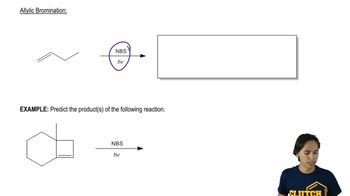
Mechanism of Allylic Bromination.

Base-Induced Dehydrohalogenation

In the second step of the synthesis, sodium amide (NaNH2) acts as a strong base to remove a hydrogen atom and a bromine atom from the vicinal dibromide, resulting in the formation of a triple bond. This process, known as dehydrohalogenation, is essential for converting the dibromide intermediate into the desired alkyne product, showcasing the importance of strong bases in elimination reactions.
Video consigliato:
03:02
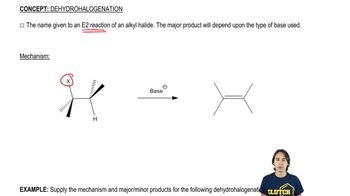
The dehydrohalogenation mechanism.