Ch. 13 - Alcohols, Ethers and Related Compounds: Substitution and Elimination
Mullins - Organic Chemistry: A Learner Centered Approach 1st Edition
Mullins1st EditionOrganic Chemistry: A Learner Centered ApproachISBN: 9780137566471Non è quello che usi tu?Cambia libro di testo
Capitolo 12, Problema 53e

The intermediates for the oxidation of isopropanol to acetone are shown. Calculate oxidation numbers for the indicated atoms, then use them to determine in which step oxidation occurs.
(e) Oxidation of isopropanol to acetone with intermediates, showing oxidation numbers for key atoms in two steps.

Guida verificata passo dopo passo
1
Identify the structure of isopropanol (C3H8O) and acetone (C3H6O). Note that isopropanol is a secondary alcohol, and acetone is a ketone.
Determine the oxidation number of the carbon atom in isopropanol that is bonded to the hydroxyl group (OH). In organic compounds, carbon typically has an oxidation number of -4, but this can vary based on its bonding.
Calculate the oxidation number of the same carbon atom in acetone. Remember that in a ketone, the carbonyl carbon is bonded to an oxygen atom, which is more electronegative.
Compare the oxidation numbers of the carbon atom in isopropanol and acetone. An increase in the oxidation number indicates oxidation.
Identify the step in the reaction mechanism where the oxidation number of the carbon atom increases, signifying the oxidation step in the conversion of isopropanol to acetone.

Risposta video verificata per un problema simile:

Questa soluzione video è stata consigliata dai nostri tutor come utile per risolvere questo problema.
Durata del video:
3m

Concetti chiave

Ecco i concetti essenziali che devi comprendere per rispondere correttamente alla domanda.

Oxidation Numbers

Oxidation numbers are a way of keeping track of electrons in atoms as they undergo chemical reactions. They are assigned to atoms based on a set of rules, such as the oxidation number of a free element being zero and the sum of oxidation numbers in a neutral compound being zero. Calculating oxidation numbers helps identify which atoms are oxidized or reduced in a reaction.
Video consigliato:
03:40
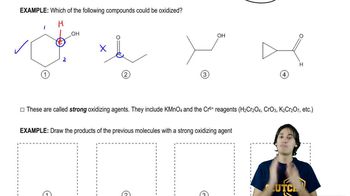
Strong oxidizing agents

Oxidation and Reduction

Oxidation is the process where an atom loses electrons, resulting in an increase in its oxidation number, while reduction is the gain of electrons, leading to a decrease in oxidation number. In organic chemistry, oxidation often involves the addition of oxygen or the removal of hydrogen. Identifying oxidation and reduction steps is crucial for understanding reaction mechanisms.
Video consigliato:
00:54
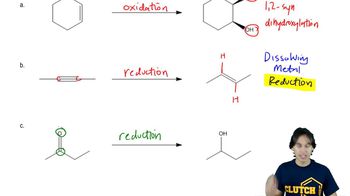
Distinguishing between Oxidation and Reduction

Reaction Intermediates

Reaction intermediates are transient species that appear in the steps between reactants and products in a chemical reaction. They are often unstable and cannot be isolated under normal conditions. Understanding intermediates is essential for mapping out the reaction pathway and determining where oxidation or reduction occurs in multi-step processes.
Video consigliato:
04:31
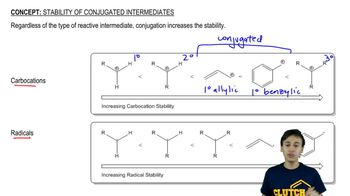
Stability of Conjugated Intermediates