Ch. 13 - Alcohols, Ethers and Related Compounds: Substitution and Elimination
Mullins - Organic Chemistry: A Learner Centered Approach 1st Edition
Mullins1st EditionOrganic Chemistry: A Learner Centered ApproachISBN: 9780137566471Non è quello che usi tu?Cambia libro di testo
Capitolo 12, Problema 29

Using an excess of HCl in the following reaction resulted in a product that was not simply the substitution of chlorine for the hydroxyl group. Predict the identity of the product obtained.

Guida verificata passo dopo passo
1
Step 1: Analyze the starting material, which is a cyclohexanol derivative. The hydroxyl group (-OH) is attached to a cyclohexane ring with a methyl group at the 1-position.
Step 2: Recognize that the reaction involves an excess of HCl. In acidic conditions, the hydroxyl group can be protonated to form water, which is a good leaving group. This sets the stage for a substitution or elimination reaction.
Step 3: Consider the possibility of carbocation formation. When the hydroxyl group leaves as water, a carbocation intermediate is formed at the 1-position. The stability of this carbocation is crucial for determining the reaction pathway.
Step 4: Evaluate the carbocation stability. The carbocation at the 1-position can undergo a hydride shift or methyl shift to form a more stable tertiary carbocation at the 2-position. This rearrangement is common in reactions involving carbocations.
Step 5: Predict the final product. Instead of simple substitution of chlorine for the hydroxyl group, the rearranged tertiary carbocation reacts with chloride ion (Cl⁻) from HCl to form a tertiary alkyl chloride at the 2-position. This explains why the product is not the direct substitution product.

Risposta video verificata per un problema simile:

Questa soluzione video è stata consigliata dai nostri tutor come utile per risolvere questo problema.
Durata del video:
4m

Concetti chiave

Ecco i concetti essenziali che devi comprendere per rispondere correttamente alla domanda.

Nucleophilic Substitution

Nucleophilic substitution is a fundamental reaction in organic chemistry where a nucleophile replaces a leaving group in a molecule. In this context, the hydroxyl group (-OH) acts as a leaving group, and HCl provides chloride ions (Cl-) that can act as nucleophiles. Understanding this mechanism is crucial for predicting the outcome of reactions involving alcohols and halogen acids.
Video consigliato:
01:47
Nucleophiles and Electrophiles can react in Substitution Reactions.

Rearrangement Reactions

Rearrangement reactions involve the structural reorganization of a molecule, often leading to the formation of more stable products. In the presence of excess HCl, the reaction may not only substitute the hydroxyl group but also rearrange the carbon skeleton, resulting in a different product than expected. Recognizing the potential for rearrangement is essential for predicting the final product.
Video consigliato:
06:08
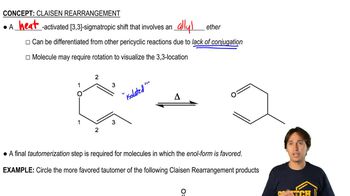
Definition of Claisen Rearrangement

Carbocation Stability

Carbocation stability is a key concept in organic chemistry that influences reaction pathways. Carbocations are positively charged carbon species that can form during nucleophilic substitution or rearrangement reactions. The stability of these intermediates, which can be primary, secondary, or tertiary, affects the likelihood of different products forming, especially when excess reagents are present.
Video consigliato:
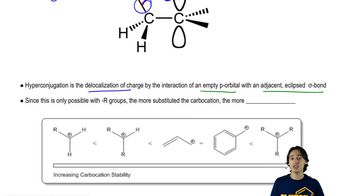
05:58
Determining Carbocation Stability