Ch. 14 - Structural Identification 1: Infrared Spectroscopy and Mass Spectrometry
Mullins - Organic Chemistry: A Learner Centered Approach 1st Edition
Mullins1st EditionOrganic Chemistry: A Learner Centered ApproachISBN: 9780137566471Non è quello che usi tu?Cambia libro di testo
Capitolo 13, Problema 15b

Choose the bond in each pair that you expect to vibrate at the higher wavenumber.
(b) C―H vs. C―O

Guida verificata passo dopo passo
1
Understand that the wavenumber in infrared (IR) spectroscopy is related to the frequency of vibration of a bond. The wavenumber is inversely proportional to the mass of the atoms involved and directly proportional to the bond strength.
Recall that lighter atoms and stronger bonds tend to vibrate at higher frequencies, resulting in higher wavenumbers.
Consider the atomic masses: Hydrogen (H) is lighter than Oxygen (O), so C―H bonds involve a lighter atom compared to C―O bonds.
Evaluate the bond strengths: C―H bonds are generally stronger than C―O bonds due to the higher electronegativity difference and shorter bond length.
Conclude that the C―H bond will vibrate at a higher wavenumber than the C―O bond because it involves a lighter atom and a stronger bond.

Risposta video verificata per un problema simile:

Questa soluzione video è stata consigliata dai nostri tutor come utile per risolvere questo problema.
Durata del video:
3m

Concetti chiave

Ecco i concetti essenziali che devi comprendere per rispondere correttamente alla domanda.

Bond Vibrational Frequency

Bond vibrational frequency refers to the energy required for a bond to stretch or compress during vibration. It is influenced by the mass of the atoms and the strength of the bond. Lighter atoms and stronger bonds typically vibrate at higher frequencies, resulting in higher wavenumbers in infrared spectroscopy.
Video consigliato:
06:00
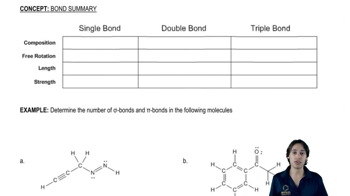
Single bonds, double bonds, and triple bonds.

Mass of Atoms

The mass of the atoms involved in a bond affects its vibrational frequency. Lighter atoms, such as hydrogen, contribute to higher vibrational frequencies compared to heavier atoms like oxygen. This is because lighter atoms can move more easily, requiring less energy to vibrate, thus increasing the wavenumber.
Video consigliato:
01:44
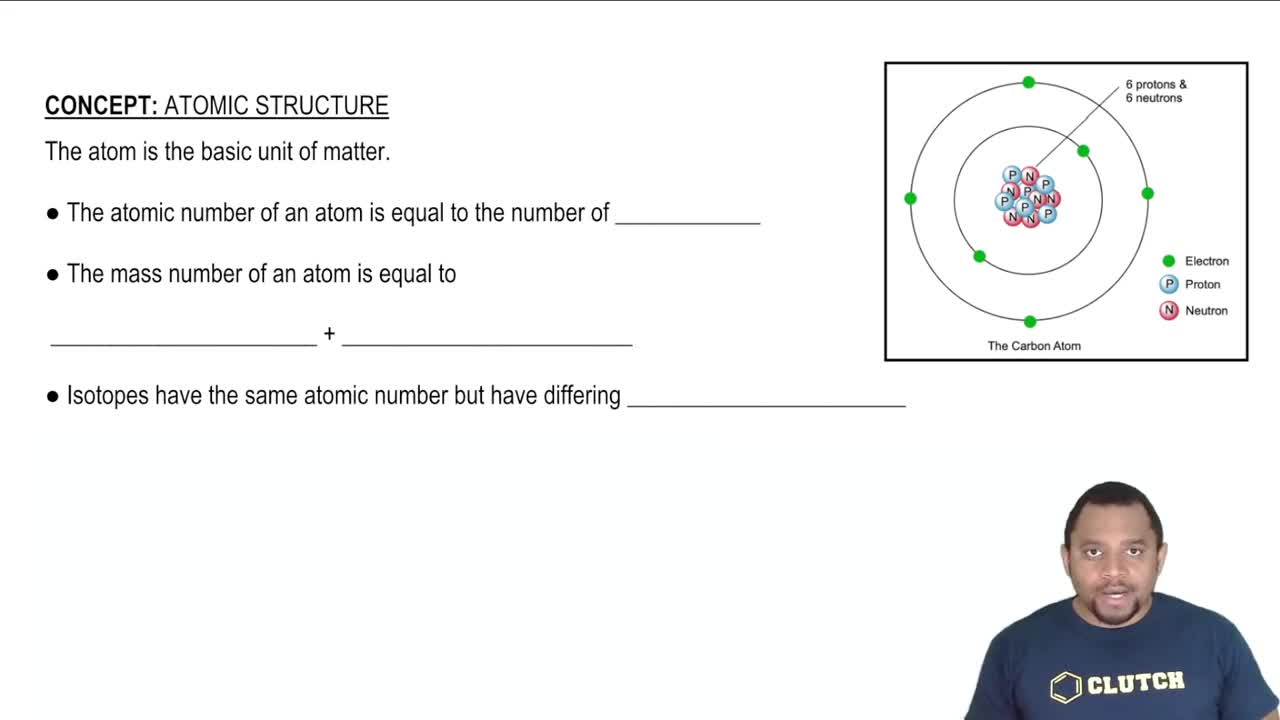
The difference between atomic numbers and atomic mass.

Bond Strength

Bond strength is a measure of how strongly two atoms are held together in a molecule. Stronger bonds, such as C-H, typically vibrate at higher frequencies than weaker bonds like C-O. This is due to the greater energy required to stretch or compress a stronger bond, leading to higher wavenumbers in spectroscopic analysis.
Video consigliato:
06:00
Single bonds, double bonds, and triple bonds.