Ch. 15 - Structural Identification 2: Nuclear Magnetic Resonance Spectroscopy
Mullins - Organic Chemistry: A Learner Centered Approach 1st Edition
Mullins1st EditionOrganic Chemistry: A Learner Centered ApproachISBN: 9780137566471Non è quello che usi tu?Cambia libro di testo
Capitolo 14, Problema 61d

Draw the signal for the following multiplicities. What is the ratio of peaks within each signal?
(d) quintet

Guida verificata passo dopo passo
1
Understand the concept of multiplicity in NMR spectroscopy: Multiplicity refers to the number of peaks observed in a signal, which is determined by the number of neighboring hydrogen atoms (n) plus one. The formula is (n+1).
Identify the quintet multiplicity: A quintet indicates that there are four neighboring hydrogen atoms. Using the formula (n+1), where n is the number of neighboring hydrogens, a quintet results from n=4.
Draw the signal for a quintet: A quintet will have five peaks. Visualize these peaks as evenly spaced lines on the spectrum, representing the splitting pattern.
Determine the ratio of peaks within a quintet: The ratio of peaks in a quintet follows Pascal's triangle, which for a quintet is 1:4:6:4:1. This means the central peak is the tallest, flanked by two smaller peaks on each side.
Consider the chemical environment: The quintet pattern is influenced by the chemical environment and the magnetic field experienced by the hydrogen atoms. Ensure that the chemical structure supports the presence of four neighboring hydrogens to produce a quintet.

Risposta video verificata per un problema simile:

Questa soluzione video è stata consigliata dai nostri tutor come utile per risolvere questo problema.
Durata del video:
2m

Concetti chiave

Ecco i concetti essenziali che devi comprendere per rispondere correttamente alla domanda.

Multiplicity in NMR Spectroscopy

Multiplicity refers to the splitting of NMR signals into multiple peaks due to interactions between neighboring non-equivalent hydrogen atoms. This splitting pattern helps determine the number of adjacent hydrogens, providing insights into the molecular structure. A quintet indicates the presence of four neighboring hydrogens.
Video consigliato:
10:06
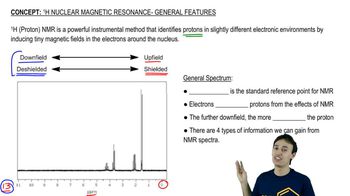
General NMR Features

Pascal's Triangle in NMR

Pascal's Triangle is used to predict the ratio of peak intensities in NMR signal multiplicities. Each row corresponds to a different multiplicity, with the coefficients representing the relative intensities of the peaks. For a quintet, the peak ratio follows the sequence 1:4:6:4:1, reflecting the distribution of signal intensities.
Video consigliato:
06:46
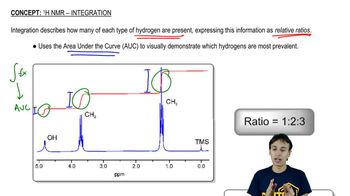
1H NMR Integration

Coupling Constant

The coupling constant (J) measures the interaction strength between neighboring nuclei, influencing the distance between peaks in a multiplet. It is expressed in Hertz (Hz) and remains consistent across the peaks of a multiplet, providing information about the spatial relationship between atoms in a molecule.
Video consigliato:
02:54
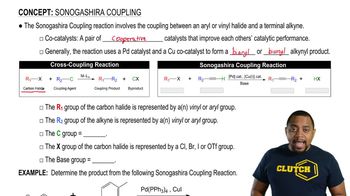
Sonogashira Coupling Reaction