Ch. 16 - Metals in Organic Chemistry
Mullins - Organic Chemistry: A Learner Centered Approach 1st Edition
Mullins1st EditionOrganic Chemistry: A Learner Centered ApproachISBN: 9780137566471Non è quello che usi tu?Cambia libro di testo
Capitolo 15, Problema 33b

Predict the product of the diorganocuprate cross-coupling reactions shown.
(b) Grignard reagent with isopropyl group reacts with cyclopentyl chloride using CuCN in a diorganocuprate cross-coupling reaction.

Guida verificata passo dopo passo
1
Identify the reactants involved in the diorganocuprate cross-coupling reaction. Typically, this involves an organohalide and a diorganocuprate reagent, such as R2CuLi.
Understand the role of the diorganocuprate reagent. In this reaction, the diorganocuprate (R2CuLi) acts as a nucleophile, where one of the R groups will replace the halide (X) on the organohalide (R'-X).
Determine which R group from the diorganocuprate will participate in the coupling. Generally, one of the R groups will transfer to the organohalide, forming a new carbon-carbon bond.
Predict the product by replacing the halide (X) on the organohalide with the R group from the diorganocuprate. The resulting product will be R'-R, where R' is the original organic group from the organohalide.
Consider any stereochemical or regiochemical outcomes if applicable. In many cases, the reaction proceeds with retention of configuration, but it's important to verify based on the specific reactants involved.

Risposta video verificata per un problema simile:

Questa soluzione video è stata consigliata dai nostri tutor come utile per risolvere questo problema.
Durata del video:
3m

Concetti chiave

Ecco i concetti essenziali che devi comprendere per rispondere correttamente alla domanda.

Diorganocuprate Reagents

Diorganocuprate reagents, typically denoted as R2CuLi, are organocopper compounds used in organic synthesis for cross-coupling reactions. They are formed by reacting organolithium compounds with copper(I) salts. These reagents are known for their ability to couple with organic halides, forming new carbon-carbon bonds, which is crucial in predicting the products of such reactions.
Video consigliato:
01:52
Reagents

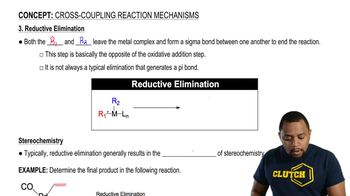
Cross-Coupling Reaction Mechanism

Cross-coupling reactions involve the formation of a new carbon-carbon bond between two different organic groups. In the context of diorganocuprate reactions, the mechanism typically involves oxidative addition of the organic halide to the copper center, followed by reductive elimination to form the coupled product. Understanding this mechanism is essential for predicting the outcome of the reaction.
Video consigliato:
03:22
Cross-Coupling Reaction Mechanisms

Regioselectivity in Coupling Reactions

Regioselectivity refers to the preference for the formation of one constitutional isomer over another in a chemical reaction. In diorganocuprate cross-coupling reactions, regioselectivity is influenced by the nature of the organic groups and the halide involved. Recognizing how these factors affect the position and type of the new bond formed is key to accurately predicting the product structure.
Video consigliato:
02:54
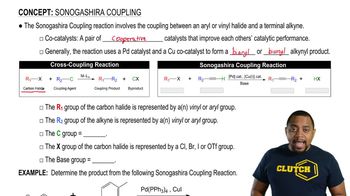
Sonogashira Coupling Reaction