Ch. 16 - Metals in Organic Chemistry
Mullins - Organic Chemistry: A Learner Centered Approach 1st Edition
Mullins1st EditionOrganic Chemistry: A Learner Centered ApproachISBN: 9780137566471Non è quello che usi tu?Cambia libro di testo
Capitolo 15, Problema 8a

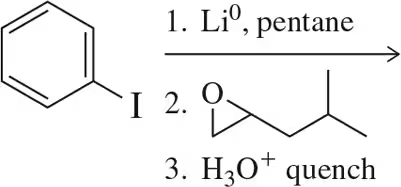
Predict the product of the following epoxide addition reactions.
(a) Chemical reaction diagram showing epoxide addition with lithium, oxygen, and hydronium quenching steps.

Guida verificata passo dopo passo
1
Identify the structure of the epoxide. An epoxide is a three-membered cyclic ether with significant ring strain, making it highly reactive toward nucleophiles.
Determine the reaction conditions. If the reaction occurs under acidic conditions, the epoxide will be protonated first, making it more electrophilic. If the reaction occurs under basic or neutral conditions, the nucleophile will directly attack the less substituted carbon of the epoxide due to steric hindrance.
Analyze the regioselectivity of the reaction. Under acidic conditions, the nucleophile typically attacks the more substituted carbon of the epoxide due to the formation of a more stable carbocation-like intermediate. Under basic conditions, the nucleophile attacks the less substituted carbon due to steric factors.
Consider the stereochemistry of the reaction. The nucleophilic attack on the epoxide occurs via an SN2 mechanism, leading to an inversion of configuration at the carbon being attacked.
Draw the product of the reaction by opening the epoxide ring and attaching the nucleophile to the appropriate carbon, ensuring that the stereochemistry and regioselectivity are consistent with the reaction conditions.

Risposta video verificata per un problema simile:

Questa soluzione video è stata consigliata dai nostri tutor come utile per risolvere questo problema.
Durata del video:
2m

Concetti chiave

Ecco i concetti essenziali che devi comprendere per rispondere correttamente alla domanda.

Epoxide Structure

Epoxides are three-membered cyclic ethers characterized by a highly strained ring structure. This strain makes them reactive intermediates in organic chemistry, allowing them to undergo various nucleophilic addition reactions. Understanding the geometry and reactivity of epoxides is crucial for predicting the outcomes of their reactions.
Video consigliato:
02:19
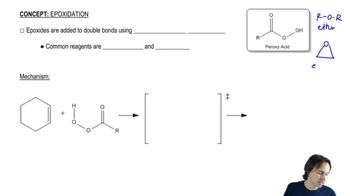
General properties of epoxidation.

Nucleophilic Addition

Nucleophilic addition is a fundamental reaction mechanism in organic chemistry where a nucleophile attacks an electrophilic center, leading to the formation of new bonds. In the case of epoxides, the nucleophile typically opens the strained ring, resulting in the formation of a diol or other products depending on the nature of the nucleophile and reaction conditions.
Video consigliato:
08:27
Nucleophilic Addition

Regioselectivity and Stereochemistry

Regioselectivity refers to the preference of a chemical reaction to yield one structural isomer over others, while stereochemistry involves the spatial arrangement of atoms in molecules. In epoxide addition reactions, the choice of nucleophile and reaction conditions can influence both the regioselectivity and stereochemistry of the product, making it essential to consider these factors when predicting the outcome.
Video consigliato:
Percorso guidato
1:38
Polymer Stereochemistry Concept 1