Suggest a mechanism for the reaction shown in Figure 16.30 using IZnCH₂I as the cyclopropanating reagent.
Ch. 16 - Metals in Organic Chemistry

Mullins1st EditionOrganic Chemistry: A Learner Centered ApproachISBN: 9780137566471Non è quello che usi tu?Cambia libro di testo
Capitolo 15, Problema 23b
Predict the product of the following Negishi coupling reactions.
(b) 
Guida verificata passo dopo passo1
Identify the organolithium reagent: The starting material is an organolithium compound, specifically isopropyllithium, which is a strong nucleophile and base.
Convert the organolithium to an organozinc reagent: The first step involves the reaction of isopropyllithium with ZnCl2 in THF to form the corresponding organozinc compound, isopropylzinc chloride.
Recognize the role of the palladium catalyst: The Pd(PPh3)4 is a common catalyst used in Negishi coupling reactions, facilitating the cross-coupling between the organozinc reagent and the organic halide.
Identify the organic halide: The organic halide in this reaction is a bromocyclopentane with a fluorine substituent, which will undergo coupling with the organozinc reagent.
Predict the product: The Negishi coupling will result in the formation of a new carbon-carbon bond between the isopropyl group from the organozinc reagent and the carbon atom of the cyclopentane ring that was bonded to the bromine, yielding the coupled product.

Risposta video verificata per un problema simile:
Questa soluzione video è stata consigliata dai nostri tutor come utile per risolvere questo problema.
Durata del video:
4mConcetti chiave
Ecco i concetti essenziali che devi comprendere per rispondere correttamente alla domanda.
Negishi Coupling Reaction
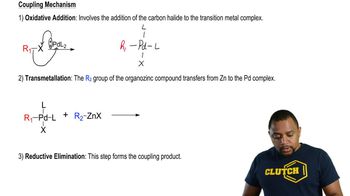
Negishi coupling is a palladium-catalyzed cross-coupling reaction that forms carbon-carbon bonds between organozinc compounds and organic halides. It is widely used in organic synthesis to construct complex molecules. The reaction typically involves a transition metal catalyst, such as palladium, and proceeds through oxidative addition, transmetalation, and reductive elimination steps.
Video consigliato:
Negishi Coupling Reaction
Transmetalation
Transmetalation is a key step in many cross-coupling reactions, including Negishi coupling, where an organometallic compound transfers its organic group to a metal catalyst. In this reaction, the organozinc species formed from the reaction of lithium reagent with ZnCl2 transfers its organic group to the palladium catalyst, facilitating the formation of the carbon-carbon bond with the organic halide.
Video consigliato:
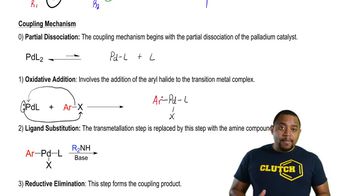
Buchwald-Hartwig Amination Reaction
Palladium Catalysis
Palladium catalysis is crucial in facilitating cross-coupling reactions like Negishi coupling. Palladium complexes, such as Pd(PPh3)4, are used to activate organic halides through oxidative addition, allowing the subsequent transmetalation and reductive elimination steps to occur. This catalysis enables the formation of new carbon-carbon bonds efficiently and selectively, making it a powerful tool in organic synthesis.
Video consigliato:
Percorso guidato
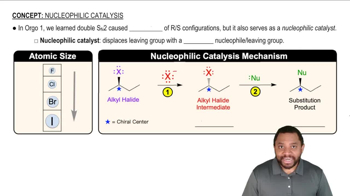
Nucleophilic Catalysis Concept 1
Pratica correlata
Domanda del libro di testo
1122
views
Domanda del libro di testo
Work backward to an appropriate organozinc halide and organohalide to make the bonds indicated by the blue arrows. There may be two possibilities for each.
(b)
547
views
Domanda del libro di testo
Predict the product of the following Stille coupling reactions.
(a)
997
views
Domanda del libro di testo
Work backward to an appropriate organozinc halide and organohalide to make the bonds indicated by the blue arrows. There may be two possibilities for each.
(a)
856
views
Domanda del libro di testo
To determine the stereochemistry of curacin A by synthesis, it would have been necessary to prepare all stereoisomers of the C₁₇―C₂₀ cyclopropane fragment. How would the reaction in Figure 16.30 be modified to produce the other stereoisomers shown here?
856
views
Domanda del libro di testo
Predict the product of the following Negishi coupling reactions.
(a)
1107
views