Ch. 16 - Metals in Organic Chemistry
Mullins - Organic Chemistry: A Learner Centered Approach 1st Edition
Mullins1st EditionOrganic Chemistry: A Learner Centered ApproachISBN: 9780137566471Non è quello che usi tu?Cambia libro di testo
Capitolo 15, Problema 31b

Predict the product of the following Sonogashira coupling reactions.
(b) Chemical structure diagram illustrating a Sonogashira coupling reaction with reactants and catalysts labeled.

Guida verificata passo dopo passo
1
Identify the reactants involved in the Sonogashira coupling reaction. The reactants are an aryl or vinyl halide and a terminal alkyne. In this case, the vinyl bromide and the terminal alkyne with a furan ring are the reactants.
Recognize the role of the catalysts and reagents. The reaction uses a palladium catalyst (Pd(PPh3)4) and a copper(I) iodide co-catalyst (CuI) in the presence of a base (iPr2NH). These facilitate the coupling of the alkyne to the vinyl halide.
Understand the mechanism of the Sonogashira coupling. The palladium catalyst first undergoes oxidative addition with the vinyl bromide, forming a palladium-vinyl complex.
The terminal alkyne is deprotonated by the base, forming a copper-acetylide intermediate. This intermediate then undergoes transmetallation with the palladium-vinyl complex, transferring the alkyne to the palladium center.
Finally, reductive elimination occurs, coupling the alkyne to the vinyl group and regenerating the palladium catalyst. The product is a conjugated enyne with the furan ring attached to the alkyne.

Risposta video verificata per un problema simile:

Questa soluzione video è stata consigliata dai nostri tutor come utile per risolvere questo problema.
Durata del video:
2m

Concetti chiave

Ecco i concetti essenziali che devi comprendere per rispondere correttamente alla domanda.

Sonogashira Coupling

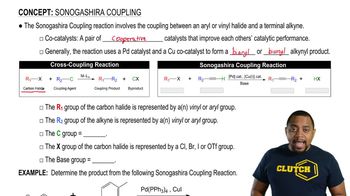
The Sonogashira coupling is a cross-coupling reaction that involves the formation of carbon-carbon bonds between terminal alkynes and aryl or vinyl halides. This reaction typically requires a palladium catalyst and a copper co-catalyst, facilitating the coupling process under mild conditions. Understanding the mechanism and the role of the catalysts is crucial for predicting the products of the reaction.
Video consigliato:
02:54
Sonogashira Coupling Reaction

Reaction Mechanism

The reaction mechanism of the Sonogashira coupling involves several key steps: oxidative addition of the aryl halide to the palladium catalyst, followed by the coordination of the alkyne, and finally, reductive elimination to form the coupled product. A clear grasp of these steps helps in predicting the structure of the final product and understanding how different substituents on the reactants can influence the outcome.
Video consigliato:
02:16
Heck Reaction Mechanism

Regioselectivity and Stereochemistry

Regioselectivity refers to the preference of a chemical reaction to yield one structural isomer over others, while stereochemistry involves the spatial arrangement of atoms in the product. In Sonogashira reactions, the nature of the substituents on the aryl halide and alkyne can significantly affect both regioselectivity and stereochemistry, impacting the final product's properties and reactivity.
Video consigliato:
Percorso guidato
1:38
Polymer Stereochemistry Concept 1