Ch. 16 - Metals in Organic Chemistry
Mullins - Organic Chemistry: A Learner Centered Approach 1st Edition
Mullins1st EditionOrganic Chemistry: A Learner Centered ApproachISBN: 9780137566471Non è quello che usi tu?Cambia libro di testo
Capitolo 15, Problema 3

Suggest a reagent for the transformation of a 1° alcohol to a 1° alkyl halide.
Diagram showing the conversion of a 1° alcohol to a 1° alkyl halide, with a question mark indicating the required reagent.

Guida verificata passo dopo passo
1
Identify the starting material and the desired product. The starting material is a primary alcohol, and the desired product is a primary alkyl bromide.
Recognize that the transformation involves replacing the hydroxyl group (-OH) of the alcohol with a bromine atom (Br).
Consider common reagents used for converting primary alcohols to primary alkyl halides. One effective reagent for this transformation is phosphorus tribromide (PBr₃).
Understand the mechanism: PBr₃ reacts with the alcohol to form an intermediate, which then undergoes a substitution reaction to replace the -OH group with a bromine atom.
Note that this reaction typically proceeds with inversion of configuration at the carbon center, which is important if the starting alcohol is chiral.

Risposta video verificata per un problema simile:

Questa soluzione video è stata consigliata dai nostri tutor come utile per risolvere questo problema.

Concetti chiave

Ecco i concetti essenziali che devi comprendere per rispondere correttamente alla domanda.

Alcohols and Their Reactivity

Alcohols are organic compounds containing a hydroxyl (-OH) group. The reactivity of alcohols varies based on their structure (primary, secondary, or tertiary) and the conditions under which they are transformed. Primary alcohols, like the one in the question, can undergo nucleophilic substitution reactions to form alkyl halides.
Video consigliato:
01:01
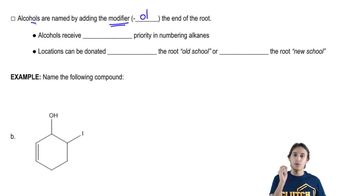
How to name alcohols

Nucleophilic Substitution Reactions

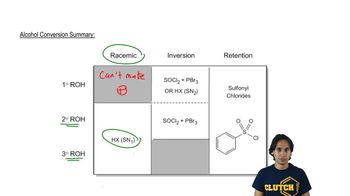
Nucleophilic substitution is a fundamental reaction in organic chemistry where a nucleophile replaces a leaving group in a molecule. For converting a primary alcohol to an alkyl halide, reagents like thionyl chloride (SOCl2) or phosphorus tribromide (PBr3) can be used, facilitating the substitution of the hydroxyl group with a halide.
Video consigliato:
01:47
Nucleophiles and Electrophiles can react in Substitution Reactions.

Reagents for Alcohol Conversion

Specific reagents are required to convert alcohols into alkyl halides effectively. Thionyl chloride and phosphorus tribromide are common choices for this transformation, as they promote the conversion through mechanisms that involve the formation of an intermediate that can easily lose the hydroxyl group and replace it with a halide.
Video consigliato:
04:30
Comparing and contrasting the Alcohol Conversions.