Ch. 17 - Carbonyl Addition Reactions: Aldehydes and Ketones
Mullins - Organic Chemistry: A Learner Centered Approach 1st Edition
Mullins1st EditionOrganic Chemistry: A Learner Centered ApproachISBN: 9780137566471Non è quello che usi tu?Cambia libro di testo
Capitolo 16, Problema 8a

Predict the product of the following aldehyde/ketone syntheses.


(a) Chemical reaction diagram showing ozonolysis steps with reactants and products indicated.

Guida verificata passo dopo passo
1
Identify the starting materials in the synthesis reaction. Aldehydes and ketones are typically synthesized through oxidation of alcohols or through specific reactions like the Friedel-Crafts acylation.
Determine the type of reaction involved. If the reaction involves an alcohol, consider oxidation reactions such as using PCC (Pyridinium chlorochromate) for converting primary alcohols to aldehydes or secondary alcohols to ketones.
If the reaction involves a carbonyl compound, consider reactions like the Grignard reaction, where a Grignard reagent adds to a carbonyl group to form an alcohol, which can then be oxidized to form a ketone or aldehyde.
Consider any reagents or catalysts mentioned in the problem. For example, if the reaction involves a carboxylic acid derivative, a reduction reaction using reagents like LiAlH4 could be involved to form an aldehyde or ketone.
Predict the structure of the product based on the reaction type and the starting materials. Ensure that the functional group transformations are consistent with the reagents and conditions provided in the problem.

Risposta video verificata per un problema simile:

Questa soluzione video è stata consigliata dai nostri tutor come utile per risolvere questo problema.

Concetti chiave

Ecco i concetti essenziali che devi comprendere per rispondere correttamente alla domanda.

Aldehydes and Ketones

Aldehydes and ketones are organic compounds characterized by the presence of a carbonyl group (C=O). Aldehydes have the carbonyl group at the end of the carbon chain, while ketones have it within the chain. Understanding their structure is crucial for predicting the products of reactions involving these compounds.
Video consigliato:
03:57
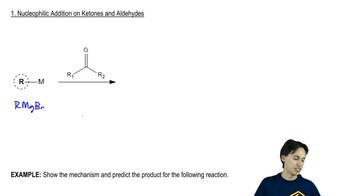
Nucleophilic Addition on Ketones and Aldehydes

Nucleophilic Addition Reactions

Nucleophilic addition reactions are fundamental in organic chemistry, particularly for carbonyl compounds. In these reactions, a nucleophile attacks the electrophilic carbon of the carbonyl group, leading to the formation of a tetrahedral intermediate. This concept is essential for predicting the products when aldehydes or ketones react with various nucleophiles.
Video consigliato:
08:27
Nucleophilic Addition

Functional Group Transformations

Functional group transformations involve the conversion of one functional group into another through chemical reactions. In the context of aldehyde and ketone syntheses, recognizing how different reagents can modify these groups is vital for predicting the final products. This includes understanding reactions like reduction, oxidation, and condensation.
Video consigliato:
02:36
Identifying Functional Groups