Ch. 17 - Carbonyl Addition Reactions: Aldehydes and Ketones
Mullins - Organic Chemistry: A Learner Centered Approach 1st Edition
Mullins1st EditionOrganic Chemistry: A Learner Centered ApproachISBN: 9780137566471Non è quello che usi tu?Cambia libro di testo
Capitolo 16, Problema 51a

Show the product expected by the Wolff–Kishner reduction of the following aldehydes/ketones.
(a)Chemical structure illustrating the Wolff–Kishner reduction process with reactants and conditions for aldehydes/ketones.

Guida verificata passo dopo passo
1
Identify the functional group in the given compound that will undergo the Wolff–Kishner reduction. In this case, it is the carbonyl group (C=O) of the ketone.
Understand that the Wolff–Kishner reduction is a method used to convert carbonyl groups into methylene groups (CH2) using hydrazine (H2NNH2) and a strong base like KOH under high temperature.
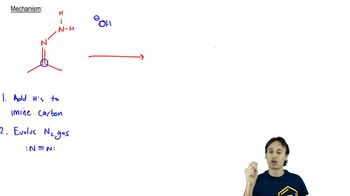
Recognize that the reaction involves the formation of a hydrazone intermediate, where the carbonyl oxygen is replaced by a hydrazine moiety, followed by the elimination of nitrogen gas (N2) to form the alkane.
Apply the Wolff–Kishner reduction to the given ketone. Replace the carbonyl group with a methylene group, effectively removing the oxygen and adding two hydrogen atoms to the carbonyl carbon.
Draw the final product structure, ensuring that the pyridine ring and the ethyl group remain unchanged, while the carbonyl carbon is now part of a methylene group, resulting in a fully saturated carbon chain.

Risposta video verificata per un problema simile:

Questa soluzione video è stata consigliata dai nostri tutor come utile per risolvere questo problema.
Durata del video:
1m

Concetti chiave

Ecco i concetti essenziali che devi comprendere per rispondere correttamente alla domanda.

Wolff–Kishner Reduction

The Wolff–Kishner reduction is a chemical reaction used to convert carbonyl compounds, such as aldehydes and ketones, into alkanes. This process involves the hydrazone formation followed by the treatment with a strong base, typically potassium hydroxide, and heating, which leads to the removal of nitrogen gas and the formation of the corresponding alkane.
Video consigliato:
04:57
Mechanism

Carbonyl Compounds

Carbonyl compounds are organic molecules that contain a carbon atom double-bonded to an oxygen atom (C=O). This functional group is characteristic of aldehydes and ketones, which differ in their structure; aldehydes have at least one hydrogen atom attached to the carbonyl carbon, while ketones have two carbon groups attached. Understanding their structure is crucial for predicting the outcome of reactions like the Wolff–Kishner reduction.
Video consigliato:
01:40
Defining meso compounds.

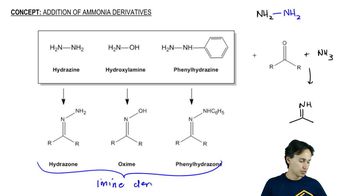
Hydrazones

Hydrazones are compounds formed by the reaction of hydrazine with carbonyl compounds, resulting in a C=N bond. In the context of the Wolff–Kishner reduction, the formation of a hydrazone intermediate is essential, as it stabilizes the carbonyl compound and facilitates the subsequent elimination of nitrogen gas, ultimately leading to the formation of the alkane product.
Video consigliato:
02:49
Ammonia Derivatives