Ch. 19 - Nucleophilic Acyl Substitution 2: Carboxylic Acid Derivatives
Mullins - Organic Chemistry: A Learner Centered Approach 1st Edition
Mullins1st EditionOrganic Chemistry: A Learner Centered ApproachISBN: 9780137566471Non è quello che usi tu?Cambia libro di testo
Capitolo 18, Problema 24

A chemist unsuccessfully attempted to produce the 1,4-cyclohexanediol by hydration of the cyclohexene shown.
(a) Provide a mechanism for the formation of the actual product.
(b) Suggest a pathway using acetyl chloride as a protecting group that will allow for the formation of the desired product.
Chemical reaction diagram showing hydration of cyclohexene, with labels for desired and actual products.

Guida verificata passo dopo passo
1
Step 1: Analyze the reaction conditions. The hydration of cyclohexene in the presence of H₂SO₄ and H₂O typically proceeds via an electrophilic addition mechanism. The double bond in cyclohexene is protonated by H₂SO₄, forming a carbocation intermediate.
Step 2: Explain the formation of the actual product. The carbocation intermediate undergoes intramolecular nucleophilic attack by the hydroxyl group already present on the molecule, leading to the formation of a cyclic ether (the actual product shown in the image). This occurs because the hydroxyl group is a better nucleophile than water under these conditions.
Step 3: Suggest a pathway using acetyl chloride as a protecting group. To prevent the hydroxyl group from reacting intramolecularly, it can be protected by converting it into an acetate ester using acetyl chloride. This reaction involves the hydroxyl group reacting with acetyl chloride to form the ester, which is less reactive under acidic conditions.
Step 4: Perform the hydration reaction. With the hydroxyl group protected, the hydration of cyclohexene can proceed as intended, forming the desired 1,4-cyclohexanediol product. The double bond is protonated, followed by nucleophilic attack by water, leading to the formation of the diol.
Step 5: Remove the protecting group. After the desired product is formed, the acetate protecting group can be removed by hydrolysis under basic conditions, regenerating the hydroxyl group and yielding the desired 1,4-cyclohexanediol.

Risposta video verificata per un problema simile:

Questa soluzione video è stata consigliata dai nostri tutor come utile per risolvere questo problema.

Concetti chiave

Ecco i concetti essenziali che devi comprendere per rispondere correttamente alla domanda.

Electrophilic Addition Mechanism

The electrophilic addition mechanism is a fundamental reaction pathway in organic chemistry where an electrophile reacts with a nucleophile, leading to the formation of a more complex molecule. In the case of cyclohexene hydration, the double bond acts as a nucleophile, attacking an electrophilic species, typically a proton (H+), resulting in the formation of a carbocation intermediate. This intermediate can then be attacked by water, leading to the formation of alcohols like cyclohexanol.
Video consigliato:
05:39
Features of Addition Mechanisms.

Protecting Groups

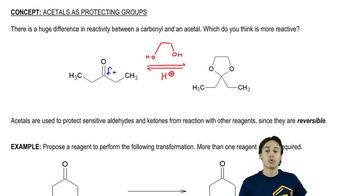
Protecting groups are temporary modifications used in organic synthesis to prevent certain functional groups from reacting during a chemical reaction. In the context of synthesizing 1,4-cyclohexanediol, acetyl chloride can be used to protect one hydroxyl group, allowing selective reactions to occur without interference. After the desired transformations are completed, the protecting group can be removed to yield the final product.
Video consigliato:
02:44
Protecting Groups

Stereochemistry of Cyclohexane Derivatives

Stereochemistry refers to the spatial arrangement of atoms in molecules and is crucial in determining the properties and reactivity of cyclohexane derivatives. In the case of 1,4-cyclohexanediol, understanding the cis and trans configurations is essential, as they can influence the stability and reactivity of the compound. The stereochemical outcome of reactions can affect the mechanism and the final product, making it important to consider during synthesis.
Video consigliato:
Percorso guidato
1:38
Polymer Stereochemistry Concept 1