Ch. 19 - Nucleophilic Acyl Substitution 2: Carboxylic Acid Derivatives
Mullins - Organic Chemistry: A Learner Centered Approach 1st Edition
Mullins1st EditionOrganic Chemistry: A Learner Centered ApproachISBN: 9780137566471Non è quello che usi tu?Cambia libro di testo
Capitolo 18, Problema 55b

Give the nitrile and organometallic reagent you would use to make the following ketones. There are two possible answers for both.
(b)

Guida verificata passo dopo passo
1
Identify the target ketone structure. A ketone has the general formula \( R_2C=O \), where \( R \) represents alkyl or aryl groups.
Recognize that nitriles can be converted to ketones using organometallic reagents. The general reaction involves the addition of an organometallic reagent to a nitrile, followed by hydrolysis.
Consider the structure of the ketone you want to synthesize. Determine the two possible alkyl or aryl groups \( R \) that could be attached to the carbonyl carbon.
Select a nitrile that corresponds to one of the \( R \) groups. The nitrile should have the formula \( R-C\equiv N \).
Choose an organometallic reagent that corresponds to the other \( R \) group. Common choices include Grignard reagents \( R-MgX \) or organolithium reagents \( R-Li \).

Risposta video verificata per un problema simile:

Questa soluzione video è stata consigliata dai nostri tutor come utile per risolvere questo problema.
Durata del video:
5m

Concetti chiave

Ecco i concetti essenziali che devi comprendere per rispondere correttamente alla domanda.

Nitrile Chemistry

Nitriles are organic compounds containing a cyano group (-C≡N) attached to a carbon atom. They are versatile intermediates in organic synthesis, often used to form ketones through reactions with organometallic reagents. Understanding the reactivity and transformation of nitriles is crucial for predicting the outcome of such reactions.
Video consigliato:
01:01
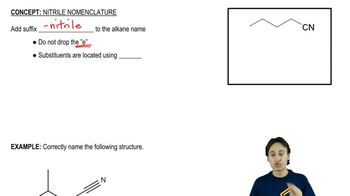
Nitrile Nomenclature

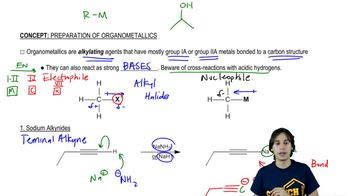
Organometallic Reagents

Organometallic reagents, such as Grignard reagents (RMgX) and organolithium compounds (RLi), are pivotal in organic synthesis for forming carbon-carbon bonds. These reagents react with nitriles to form ketones by adding the organic group to the carbon of the cyano group, followed by hydrolysis. Mastery of their reactivity and selectivity is essential for successful ketone synthesis.
Video consigliato:
02:50
Ruining Organometallics

Ketone Formation

Ketones are carbonyl compounds characterized by a carbon atom double-bonded to an oxygen atom and two alkyl or aryl groups. In organic synthesis, ketones can be formed by reacting nitriles with organometallic reagents, which adds an organic group to the nitrile, followed by hydrolysis. Understanding the mechanisms and conditions for ketone formation is key to designing effective synthetic routes.
Video consigliato:
02:27
Name the ketone