
Ch. 19 - Nucleophilic Acyl Substitution 2: Carboxylic Acid Derivatives
Mullins - Organic Chemistry: A Learner Centered Approach 1st Edition
Mullins1st EditionOrganic Chemistry: A Learner Centered ApproachISBN: 9780137566471Non è quello che usi tu?Cambia libro di testo
Capitolo 18, Problema 39c

Predict the product of the following reaction sequences.
(c) Chemical reaction sequence with reactants and conditions for predicting product formation.

Guida verificata passo dopo passo
1
Step 1: Analyze the starting material, which is a cyclic amide (lactam). The structure contains a five-membered ring with an amide group.
Step 2: The first reaction involves H2SO4, H2O, and heat. This is typically a hydrolysis reaction where the amide is converted into a carboxylic acid. The cyclic amide will open up to form a linear carboxylic acid.
Step 3: The second step involves SOCl2, which is used to convert carboxylic acids into acyl chlorides. The carboxylic acid formed in the previous step will be transformed into an acyl chloride.
Step 4: The third step uses LiAlH(Ot-Bu)3, a reducing agent that selectively reduces acyl chlorides to aldehydes. The acyl chloride from the previous step will be reduced to an aldehyde.
Step 5: Consider the overall transformation from the cyclic amide to the aldehyde, noting the changes in functional groups and the reagents used at each step.

Risposta video verificata per un problema simile:

Questa soluzione video è stata consigliata dai nostri tutor come utile per risolvere questo problema.
Durata del video:
2m

Concetti chiave

Ecco i concetti essenziali che devi comprendere per rispondere correttamente alla domanda.

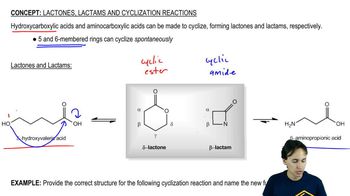
Hydrolysis of Lactams

Lactams are cyclic amides that can undergo hydrolysis in the presence of acid and water, especially under heating conditions. This reaction breaks the amide bond, converting the lactam into a linear carboxylic acid and an amine. In this sequence, the use of H2SO4 and heat facilitates the hydrolysis of the lactam ring, leading to the formation of a carboxylic acid.
Video consigliato:
05:19
Lactones and Lactams

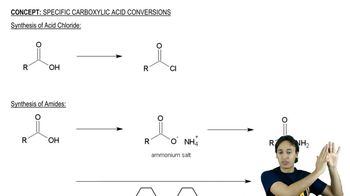
Conversion of Carboxylic Acids to Acyl Chlorides

Carboxylic acids can be converted into acyl chlorides using thionyl chloride (SOCl2). This reaction involves the substitution of the hydroxyl group of the carboxylic acid with a chlorine atom, forming an acyl chloride. Acyl chlorides are more reactive than carboxylic acids and are useful intermediates in organic synthesis.
Video consigliato:
01:36
Synthesis of Acid Chlorides

Selective Reduction of Acyl Chlorides

Lithium tri-tert-butoxyaluminum hydride (LiAlH(Ot-Bu)3) is a selective reducing agent used to convert acyl chlorides to aldehydes. Unlike other hydride reagents, it does not reduce the aldehyde further to an alcohol. This selectivity is crucial for synthesizing aldehydes from acyl chlorides without over-reduction, allowing for controlled product formation in multi-step synthesis.
Video consigliato:
01:57
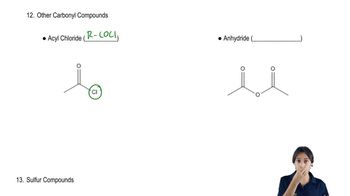
Recognizing acyl chlorides and anhydrides.