A chemistry student drew the following incorrect electron configuration for carbon. (a) Correct the diagram.
Ch. 2 - General Chemistry Translated: Finding the Electrons

Mullins1st EditionOrganic Chemistry: A Learner Centered ApproachISBN: 9780137566471Non è quello che usi tu?Cambia libro di testo
Tutti i libri di testo
Mullins 1st Edition
Ch. 2 - General Chemistry Translated: Finding the Electrons
Problema 8
Mullins 1st Edition
Ch. 2 - General Chemistry Translated: Finding the Electrons
Problema 8Capitolo 1, Problema 8
Chlorine exists as one of two isotopes with atomic masses of 34.969 amu (35Cl) and 36.966 amu (37Cl) . Calculate the relative abundance of 35Cl and 37Cl based on the average atomic mass of 35.453 amu.
Guida verificata passo dopo passo1
Define the variables: Let the relative abundance of ³⁵Cl be x, and the relative abundance of ³⁷Cl be (1 - x), since the total abundance must equal 1.
Write the equation for the average atomic mass of chlorine: .
Distribute the terms in the equation: , which expands to .
Combine like terms: Simplify the equation to .
Rearrange the equation to solve for x: Subtract 36.966 from both sides, then divide by -1.997 to isolate x. The value of x represents the relative abundance of ³⁵Cl, and (1 - x) gives the relative abundance of ³⁷Cl.

Risposta video verificata per un problema simile:
Questa soluzione video è stata consigliata dai nostri tutor come utile per risolvere questo problema.
Durata del video:
6mConcetti chiave
Ecco i concetti essenziali che devi comprendere per rispondere correttamente alla domanda.
Isotopes
Isotopes are variants of a chemical element that have the same number of protons but different numbers of neutrons, resulting in different atomic masses. For chlorine, the isotopes ³⁵Cl and ³⁷Cl have atomic masses of 34.969 amu and 36.966 amu, respectively. Understanding isotopes is crucial for calculations involving average atomic mass and relative abundance.
Video consigliato:
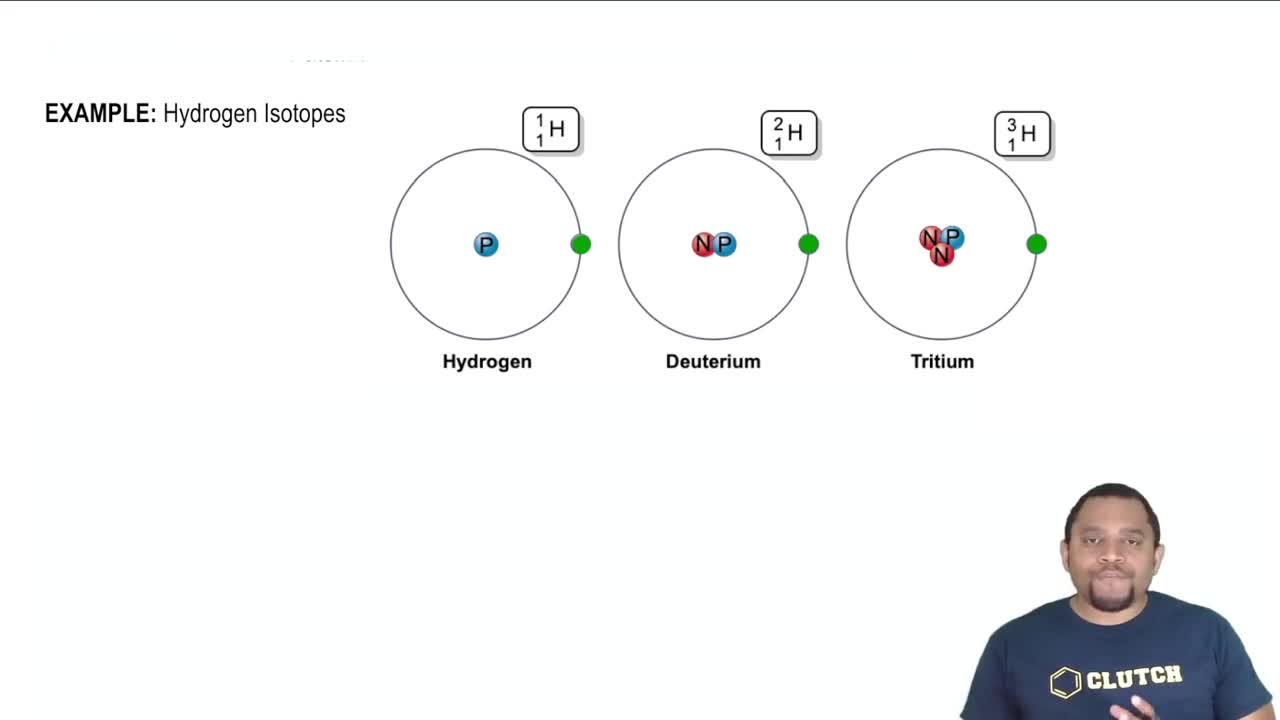
Understanding the hydrogen isotopes.
Average Atomic Mass
The average atomic mass of an element is a weighted average of the masses of its isotopes, taking into account their relative abundances. In this case, the average atomic mass of chlorine is given as 35.453 amu. This value is essential for determining the proportions of each isotope present in a sample.
Video consigliato:
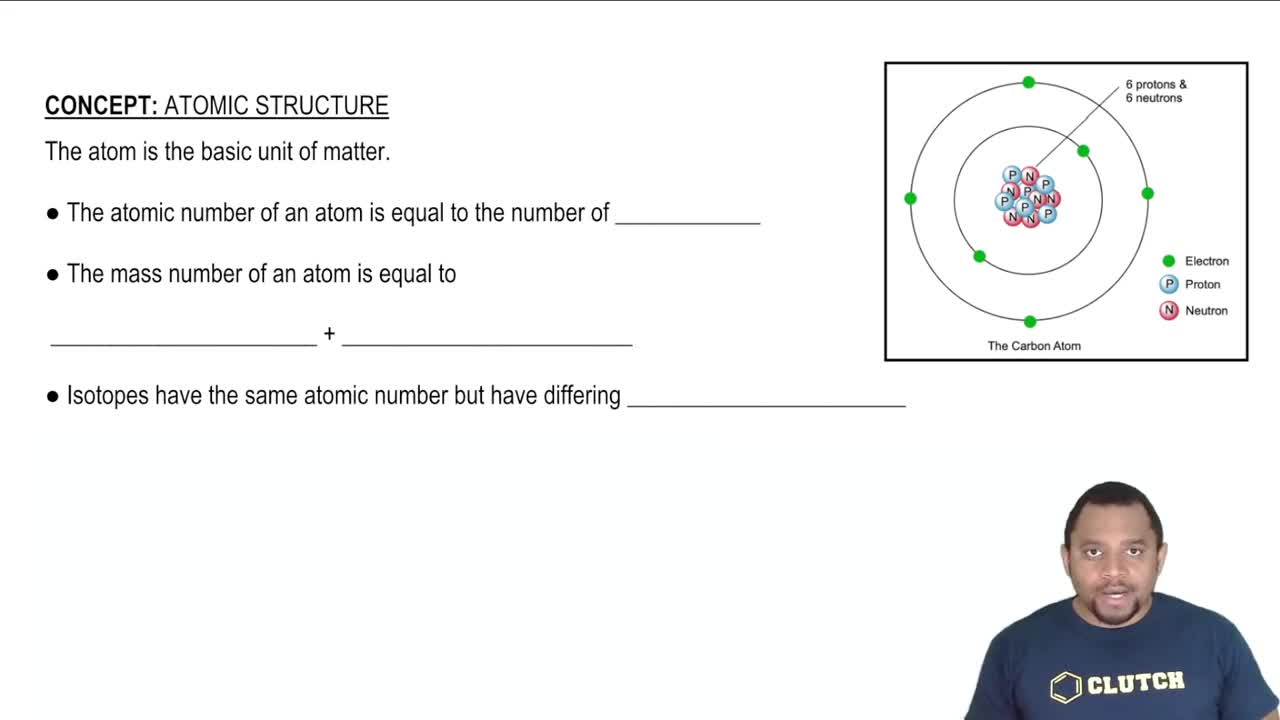
The difference between atomic numbers and atomic mass.
Relative Abundance
Relative abundance refers to the proportion of each isotope of an element present in a sample, usually expressed as a percentage. To calculate the relative abundance of ³⁵Cl and ³⁷Cl, one can set up equations based on the average atomic mass and the known masses of the isotopes. This concept is fundamental for understanding how isotopes contribute to the overall atomic mass of an element.
Video consigliato:
Explaining relative rates of halogenation.
Pratica correlata
Domanda del libro di testo
861
views
Domanda del libro di testo
Why is argon considered to be so stable that it is referred to as a noble gas?
1466
views
Domanda del libro di testo
Would you expect electrons in the 2s or 3s orbital to be more reactive? Why?
1251
views
Domanda del libro di testo
How many valence shell electrons do each of the following elements contain? How many new bonds can each form?
(c) O
1283
views
Domanda del libro di testo
A chemistry student drew the following incorrect electron configuration for carbon. (b) Which rule wasn't followed by the student?
1436
views
Domanda del libro di testo
Bromine-79 (50.7% abundance) has an atomic mass of 78.918 amu, whereas bromine-81 (49.3% abundance) has an atomic mass of 80.916 amu. From these data, calculate the average atomic mass of bromine that you would expect to see in the periodic table.
1281
views