Ch. 20 - Enolates: Carbonyl Addition and Substitution
Mullins - Organic Chemistry: A Learner Centered Approach 1st Edition
Mullins1st EditionOrganic Chemistry: A Learner Centered ApproachISBN: 9780137566471Non è quello che usi tu?Cambia libro di testo
Capitolo 19, Problema 15a

Which of the following SN2 and E2 reactions, respectively, is faster? Justify your choice.
(a) Comparison of SN2 and E2 reactions showing reactants and products with NaOH and water as reagents.

Guida verificata passo dopo passo
1
Step 1: Analyze the reaction conditions for each case. In the first reaction, NaOH is used as the nucleophile in an aqueous solution, which promotes an SN2 mechanism due to the strong nucleophilicity of OH⁻. In the second reaction, H₂O acts as the nucleophile, which is weaker and favors an SN1 mechanism rather than SN2.
Step 2: Consider the substrate structure. Both reactions involve a primary alkyl bromide (CH₃CH₂Br), which is highly favorable for SN2 reactions due to minimal steric hindrance around the electrophilic carbon.
Step 3: Compare the nucleophiles. OH⁻ is a stronger nucleophile than H₂O because it is negatively charged and more reactive. This makes the first reaction faster under SN2 conditions.
Step 4: Evaluate the solvent effects. The first reaction occurs in a polar aprotic environment (NaOH in H₂O), which enhances the nucleophilicity of OH⁻ and accelerates the SN2 reaction. The second reaction occurs in a polar protic solvent (H₂O), which stabilizes the nucleophile and slows down the SN2 reaction.
Step 5: Conclude that the first reaction (NaOH in H₂O) is faster for the SN2 mechanism due to the stronger nucleophile and favorable reaction conditions. For E2 reactions, the analysis would depend on the presence of a strong base and the substrate's ability to undergo elimination, which is not explicitly shown in the given problem.

Risposta video verificata per un problema simile:

Questa soluzione video è stata consigliata dai nostri tutor come utile per risolvere questo problema.

Concetti chiave

Ecco i concetti essenziali che devi comprendere per rispondere correttamente alla domanda.

SN2 Reactions

SN2 (Substitution Nucleophilic Bimolecular) reactions involve a nucleophile attacking an electrophile in a single concerted step, resulting in the displacement of a leaving group. The reaction rate depends on the concentration of both the nucleophile and the substrate, making it second-order. Steric hindrance significantly affects the rate, with primary substrates reacting faster than secondary or tertiary ones.
Video consigliato:
11:57
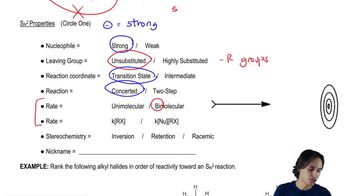
Understanding the properties of SN2.

E2 Reactions

E2 (Elimination Bimolecular) reactions are characterized by the simultaneous removal of a leaving group and a hydrogen atom from adjacent carbon atoms, leading to the formation of a double bond. This reaction also occurs in a single step and is second-order, depending on the concentrations of both the substrate and the base. The reaction rate is influenced by the strength of the base and the structure of the substrate, with bulky bases favoring more sterically accessible sites.
Video consigliato:
00:27
E2 Cumulative Intro

Reaction Conditions

The rate of SN2 and E2 reactions can be influenced by various factors, including solvent type, temperature, and substrate structure. Polar aprotic solvents favor SN2 reactions by stabilizing the nucleophile without solvation, while strong bases and high temperatures enhance E2 reactions. Understanding these conditions is crucial for predicting which reaction will proceed faster under specific circumstances.
Video consigliato:
Percorso guidato
1:18
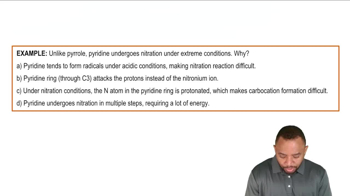
EAS Reactions of Pyridine Example 1