Ch. 21 - Conjugated Systems 1: Stability and Addition Reactions
Mullins - Organic Chemistry: A Learner Centered Approach 1st Edition
Mullins1st EditionOrganic Chemistry: A Learner Centered ApproachISBN: 9780137566471Non è quello che usi tu?Cambia libro di testo
Capitolo 20, Problema 25

Identify the HOMO and LUMO of the allylic cation and the allylic anion shown in Figure 21.22.
<IMAGE>

Guida verificata passo dopo passo
1
Step 1: Understand the concepts of HOMO (Highest Occupied Molecular Orbital) and LUMO (Lowest Unoccupied Molecular Orbital). HOMO represents the molecular orbital containing the highest energy electrons, while LUMO represents the molecular orbital that is ready to accept electrons.
Step 2: Recall that allylic systems involve conjugation, where π-electrons are delocalized over three atoms. This delocalization creates molecular orbitals with different energy levels.
Step 3: For the allylic cation, note that it has one fewer electron in the π-system compared to the neutral allylic species. This means the HOMO will be the highest-energy π-orbital that is occupied, and the LUMO will be the next higher-energy π-orbital that is unoccupied.
Step 4: For the allylic anion, note that it has one additional electron in the π-system compared to the neutral allylic species. This means the HOMO will be the highest-energy π-orbital that is occupied, and the LUMO will be the next higher-energy π-orbital that is unoccupied.
Step 5: To identify the specific molecular orbitals, analyze the energy diagram of the allylic system (Figure 21.22). The allylic cation will have a lower HOMO energy due to the electron deficiency, while the allylic anion will have a higher HOMO energy due to the extra electron. The LUMO for both species will depend on the next available unoccupied orbital in the π-system.

Risposta video verificata per un problema simile:

Questa soluzione video è stata consigliata dai nostri tutor come utile per risolvere questo problema.
Durata del video:
8m

Concetti chiave

Ecco i concetti essenziali che devi comprendere per rispondere correttamente alla domanda.

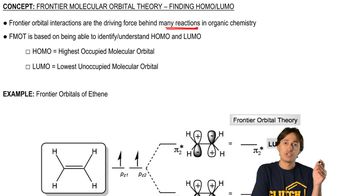
HOMO and LUMO

HOMO (Highest Occupied Molecular Orbital) and LUMO (Lowest Unoccupied Molecular Orbital) are fundamental concepts in molecular orbital theory. The HOMO is the highest energy orbital that contains electrons, while the LUMO is the lowest energy orbital that is empty. The energy gap between these two orbitals is crucial for understanding the reactivity and stability of molecules, as it influences how they interact with other species.
Video consigliato:
02:35
HOMO vs. LUMO

Allylic Cation and Anion

An allylic cation is a positively charged species where the positive charge is located on a carbon atom adjacent to a double bond, while an allylic anion has a negative charge on a similar carbon atom. These species are important in organic chemistry due to their unique stability and reactivity patterns, which arise from resonance stabilization. Understanding their structure helps in predicting their behavior in chemical reactions.
Video consigliato:
Percorso guidato
1:06
Anionic Polymerization Concept 4

Resonance

Resonance is a concept used to describe the delocalization of electrons in molecules where the electron distribution cannot be represented by a single Lewis structure. In the case of allylic cations and anions, resonance allows for the charge to be spread over multiple atoms, enhancing stability. This delocalization is key to understanding the properties and reactivity of these intermediates in organic reactions.
Video consigliato:
03:04
Drawing Resonance Structures