Ch. 22 - Conjugated Systems 2: Pericyclic Reactions
Mullins - Organic Chemistry: A Learner Centered Approach 1st Edition
Mullins1st EditionOrganic Chemistry: A Learner Centered ApproachISBN: 9780137566471Non è quello che usi tu?Cambia libro di testo
Capitolo 21, Problema 23d

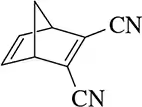
Give the diene and dienophile that could be used to make the following Diels–Alder products.
(d) Chemical structure of a bicyclic compound with two cyano groups (CN) attached to a six-membered ring.

Guida verificata passo dopo passo
1
Identify the Diels–Alder product structure given in the problem. The Diels–Alder reaction involves a [4+2] cycloaddition between a diene and a dienophile, resulting in a cyclohexene ring.
Examine the product to determine the positions of the new sigma bonds formed during the reaction. This will help in identifying the original diene and dienophile.
Determine the structure of the diene. The diene is a conjugated system with two double bonds. Look for the part of the product that corresponds to the four-carbon chain with two double bonds.
Identify the dienophile. The dienophile is typically an alkene or alkyne that reacts with the diene. In the product, it corresponds to the two-carbon unit that forms a new bond with the diene.
Consider any substituents or stereochemistry in the product. This can provide clues about the substituents on the diene and dienophile before the reaction. Ensure that the stereochemistry in the product matches the expected outcome of the Diels–Alder reaction.

Risposta video verificata per un problema simile:

Questa soluzione video è stata consigliata dai nostri tutor come utile per risolvere questo problema.

Concetti chiave

Ecco i concetti essenziali che devi comprendere per rispondere correttamente alla domanda.

Diels–Alder Reaction

The Diels–Alder reaction is a [4+2] cycloaddition reaction between a conjugated diene and a dienophile, typically an alkene or alkyne, to form a six-membered ring. This reaction is a cornerstone of organic synthesis due to its ability to form complex cyclic structures in a stereospecific manner. Understanding the electronic and steric requirements of both the diene and dienophile is crucial for predicting the outcome of the reaction.
Video consigliato:
04:02
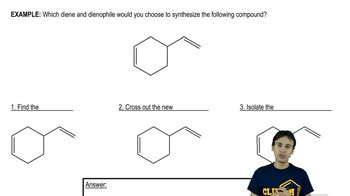
Diels-Alder Retrosynthesis

Conjugated Diene

A conjugated diene consists of two double bonds separated by a single bond, allowing for electron delocalization across the π-system. This delocalization stabilizes the diene and is essential for its reactivity in the Diels–Alder reaction. The s-cis conformation of the diene is particularly reactive, as it allows the p-orbitals to overlap effectively with those of the dienophile during the cycloaddition process.
Video consigliato:
03:27
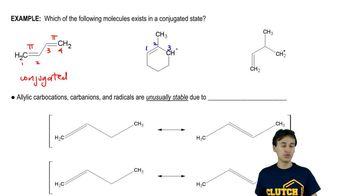
Conjugated states

Dienophile

A dienophile is an electron-deficient alkene or alkyne that participates in the Diels–Alder reaction by reacting with a conjugated diene. The presence of electron-withdrawing groups on the dienophile enhances its reactivity by making it more electrophilic. Understanding the electronic nature of the dienophile is crucial for predicting the regioselectivity and stereochemistry of the Diels–Alder product.
Video consigliato:
09:48
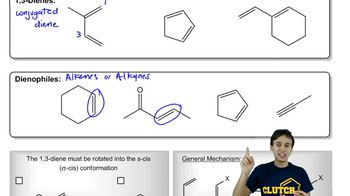
General Features