Ch. 22 - Conjugated Systems 2: Pericyclic Reactions
Mullins - Organic Chemistry: A Learner Centered Approach 1st Edition
Mullins1st EditionOrganic Chemistry: A Learner Centered ApproachISBN: 9780137566471Non è quello che usi tu?Cambia libro di testo
Capitolo 21, Problema 43a

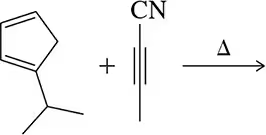
Predict the product of the following reactions. [When all of the reactions from this chapter are shown together, you must first decide which type of reaction each is. Is it a Diels–Alder, an electrocyclic, or a sigmatropic rearrangement? Drawing the product will be easier once this determination is made.]
(a) Chemical reaction diagram showing a diene and dienophile with a CN group, indicating a Diels-Alder reaction.

Guida verificata passo dopo passo
1
Identify the type of reaction: Examine the reactants and determine if the reaction is a Diels–Alder, electrocyclic, or sigmatropic rearrangement. Look for characteristic features such as conjugated dienes for Diels–Alder reactions or cyclic systems for electrocyclic reactions.
Analyze the reactants: For a Diels–Alder reaction, identify the diene and the dienophile. For an electrocyclic reaction, identify the cyclic system and the number of π electrons involved. For a sigmatropic rearrangement, identify the migrating group and the type of shift (e.g., [1,3]-shift).
Apply the reaction mechanism: For a Diels–Alder reaction, draw the cyclic transition state and predict the stereochemistry of the product. For an electrocyclic reaction, determine whether the reaction is conrotatory or disrotatory based on the number of π electrons. For a sigmatropic rearrangement, draw the transition state and predict the new position of the migrating group.
Draw the product: Based on the mechanism and stereochemistry, draw the structure of the product. Ensure that all atoms and bonds are correctly represented, and check for any stereochemical implications.
Verify the product: Double-check the reaction type and mechanism to ensure that the predicted product is consistent with the known outcomes of such reactions. Consider any possible side reactions or alternative products that might form under the given conditions.

Risposta video verificata per un problema simile:

Questa soluzione video è stata consigliata dai nostri tutor come utile per risolvere questo problema.
Durata del video:
3m

Concetti chiave

Ecco i concetti essenziali che devi comprendere per rispondere correttamente alla domanda.

Diels–Alder Reaction

The Diels–Alder reaction is a [4+2] cycloaddition between a conjugated diene and a dienophile, forming a six-membered ring. It is a pericyclic reaction that proceeds via a concerted mechanism, meaning bonds are formed and broken simultaneously. This reaction is stereospecific and often used to synthesize complex cyclic structures in organic chemistry.
Video consigliato:
04:02
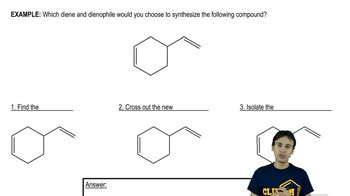
Diels-Alder Retrosynthesis

Electrocyclic Reaction

Electrocyclic reactions involve the conversion of a conjugated polyene into a cyclic compound through the rotation of a terminal bond. These reactions are governed by the Woodward-Hoffmann rules, which predict the stereochemistry based on the number of π electrons and whether the reaction is thermal or photochemical. Understanding these rules is crucial for predicting the product's stereochemistry.
Video consigliato:
08:11
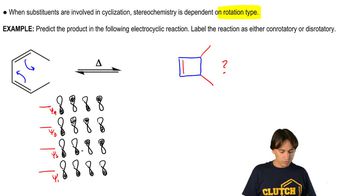
Predicting Electrocyclic Products

Sigmatropic Rearrangement

Sigmatropic rearrangements are a type of pericyclic reaction where a σ-bond migrates across a π-system, resulting in a new σ-bond formation. These rearrangements are classified by the number of atoms involved in the migration, denoted as [i,j] shifts. The reaction's feasibility and stereochemistry are influenced by orbital symmetry and the number of electrons involved.
Video consigliato:
03:20
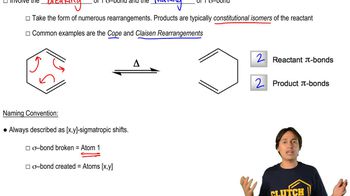
Nomenclature of Sigmatropic Shifts