Ch. 22 - Conjugated Systems 2: Pericyclic Reactions
Mullins - Organic Chemistry: A Learner Centered Approach 1st Edition
Mullins1st EditionOrganic Chemistry: A Learner Centered ApproachISBN: 9780137566471Non è quello che usi tu?Cambia libro di testo
Capitolo 21, Problema 35

Provide a mechanism of the Diels–Alder reaction shown and predict the regioisomer that will form.
Chemical reaction showing Diels-Alder mechanism with maleic anhydride and benzoic acid forming two possible regioisomers.

Guida verificata passo dopo passo
1
Identify the diene and the dienophile in the reaction. The diene should have a conjugated system of four π-electrons, and the dienophile typically contains a double or triple bond with electron-withdrawing groups.
Draw the diene in the s-cis conformation, which is necessary for the Diels–Alder reaction to occur. This conformation allows the p orbitals to overlap effectively with those of the dienophile.
Illustrate the concerted mechanism of the Diels–Alder reaction. This involves a cyclic transition state where the π-electrons from the diene and the dienophile form new σ-bonds, resulting in a six-membered ring.
Consider the regioselectivity of the reaction. Use the electron-withdrawing and electron-donating groups on the diene and dienophile to predict the major regioisomer. The most stable product is typically formed when the electron-rich end of the diene aligns with the electron-poor end of the dienophile.
Draw the predicted regioisomer, ensuring that the stereochemistry is consistent with the endo rule, which states that substituents on the dienophile prefer to be oriented towards the electron-rich diene in the transition state, leading to the endo product.

Risposta video verificata per un problema simile:

Questa soluzione video è stata consigliata dai nostri tutor come utile per risolvere questo problema.

Concetti chiave

Ecco i concetti essenziali che devi comprendere per rispondere correttamente alla domanda.

Diels–Alder Reaction

The Diels–Alder reaction is a [4+2] cycloaddition reaction between a conjugated diene and a dienophile, forming a six-membered ring. It is a pericyclic reaction that proceeds through a concerted mechanism, meaning bonds are formed and broken simultaneously. This reaction is stereospecific and can produce different regioisomers depending on the substituents on the diene and dienophile.
Video consigliato:
04:02
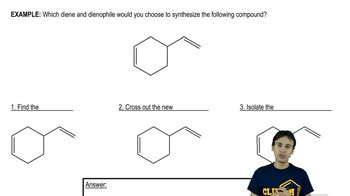
Diels-Alder Retrosynthesis

Regioselectivity

Regioselectivity in the Diels–Alder reaction refers to the preference for the formation of one regioisomer over another. This is influenced by the electronic and steric properties of the substituents on the diene and dienophile. Typically, electron-withdrawing groups on the dienophile and electron-donating groups on the diene guide the regioselectivity, often following the 'ortho-para' rule for the most stable product.
Video consigliato:
05:09
Heck Reaction

Mechanism of Cycloaddition

The mechanism of the Diels–Alder reaction involves the overlap of the π-orbitals of the diene and dienophile, forming new σ-bonds in a cyclic transition state. This concerted process does not involve intermediates, and the reaction's stereochemistry is determined by the orientation of the reactants. Understanding the orbital interactions and transition state helps predict the stereochemistry and regioselectivity of the product.
Video consigliato:
13:22
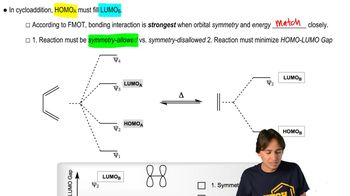
MO Theory of Thermal Cycloadditions