Ch. 23 - Benzene 1: Aromatic Stability and Substitution Reactions
Mullins - Organic Chemistry: A Learner Centered Approach 1st Edition
Mullins1st EditionOrganic Chemistry: A Learner Centered ApproachISBN: 9780137566471Non è quello che usi tu?Cambia libro di testo
Capitolo 22, Problema 5a

Suggest an arrow-pushing mechanism that accounts for the formation of the following Lewis acid–Lewis base complexes. Label the Lewis acid and Lewis base in each.
(a) Diagram illustrating the reaction between chlorine and iron(III) chloride, showing Lewis acid-base interaction.

Guida verificata passo dopo passo
1
Step 1: Identify the Lewis acid and Lewis base in the reaction. A Lewis acid is an electron pair acceptor, while a Lewis base is an electron pair donor. Look for species with an empty orbital (Lewis acid) and species with a lone pair of electrons (Lewis base).
Step 2: Draw the starting structures of the reactants. Represent the Lewis acid with its empty orbital and the Lewis base with its lone pair of electrons clearly visible.
Step 3: Use curved arrows to show the movement of electrons. The arrow should originate from the lone pair on the Lewis base and point toward the empty orbital of the Lewis acid, indicating the formation of a coordinate covalent bond.
Step 4: Draw the resulting Lewis acid–Lewis base complex. This should show the Lewis acid and Lewis base connected via the newly formed bond, with the lone pair of electrons now shared between the two species.
Step 5: Verify the mechanism by ensuring that all atoms obey the octet rule (if applicable) and that the electron movement is consistent with the properties of the Lewis acid and Lewis base.

Risposta video verificata per un problema simile:

Questa soluzione video è stata consigliata dai nostri tutor come utile per risolvere questo problema.
Durata del video:
2m

Concetti chiave

Ecco i concetti essenziali che devi comprendere per rispondere correttamente alla domanda.

Lewis Acids and Bases

Lewis acids are species that can accept an electron pair, while Lewis bases are species that can donate an electron pair. This definition expands beyond traditional Brønsted-Lowry acids and bases, allowing for a broader understanding of acid-base reactions. In the context of the question, identifying the Lewis acid and base is crucial for proposing an appropriate arrow-pushing mechanism.
Video consigliato:
02:49
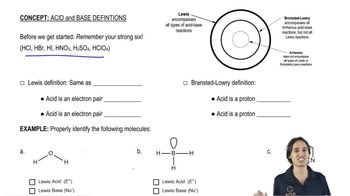
The Lewis definition of acids and bases.

Arrow-Pushing Mechanism

Arrow-pushing mechanisms are a way to illustrate the movement of electrons during chemical reactions. In these diagrams, arrows represent the flow of electron pairs, indicating how bonds are formed or broken. Understanding this mechanism is essential for visualizing how Lewis acids and bases interact to form complexes, as it helps clarify the electron transfer process.
Video consigliato:
04:32
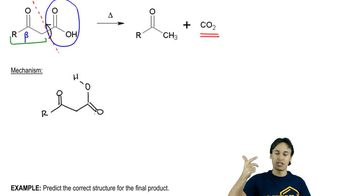
General Mechanism

Formation of Lewis Acid-Base Complexes

The formation of Lewis acid-base complexes involves the interaction between a Lewis acid and a Lewis base, resulting in a coordinate covalent bond. This process is characterized by the donation of an electron pair from the base to the acid. Recognizing the nature of these complexes is vital for predicting the stability and reactivity of the resulting species in organic chemistry.
Video consigliato:
02:49
The Lewis definition of acids and bases.