Ch. 24 - Benzene 2: Reactions Influenced by the Aromatic Ring
Mullins - Organic Chemistry: A Learner Centered Approach 1st Edition
Mullins1st EditionOrganic Chemistry: A Learner Centered ApproachISBN: 9780137566471Non è quello che usi tu?Cambia libro di testo
Capitolo 23, Problema 34d

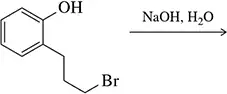
Predict the product(s) of the following reactions.
(d) Chemical structure of a brominated aromatic compound with a hydroxyl group, showing reaction conditions with NaOH and water.

Guida verificata passo dopo passo
1
Step 1: Analyze the reaction conditions provided in the problem. Determine the type of reaction taking place (e.g., substitution, elimination, addition, oxidation, reduction, etc.) based on the reagents and reaction environment.
Step 2: Identify the functional groups present in the reactant molecule. Functional groups play a key role in determining the reactivity and the type of product formed.
Step 3: Consider the mechanism of the reaction. For example, if the reaction involves nucleophilic substitution, determine whether it follows an SN1 or SN2 pathway based on the structure of the reactant and the nature of the nucleophile.
Step 4: Predict the stereochemistry of the product(s), if applicable. For instance, if the reaction involves a chiral center, assess whether the product will be racemic, retain configuration, or invert configuration.
Step 5: Write the chemical structure of the product(s) based on the mechanism and stereochemical considerations. Ensure that all atoms, bonds, and charges are correctly represented in the final product(s).

Risposta video verificata per un problema simile:

Questa soluzione video è stata consigliata dai nostri tutor come utile per risolvere questo problema.
Durata del video:
2m

Concetti chiave

Ecco i concetti essenziali che devi comprendere per rispondere correttamente alla domanda.

Reaction Mechanisms

Understanding reaction mechanisms is crucial in organic chemistry as they describe the step-by-step process by which reactants transform into products. This includes identifying intermediates, transition states, and the movement of electrons. Familiarity with mechanisms helps predict the outcome of reactions and the stability of products formed.
Video consigliato:
02:16
Heck Reaction Mechanism

Functional Groups

Functional groups are specific groups of atoms within molecules that are responsible for the characteristic chemical reactions of those molecules. Recognizing functional groups allows chemists to predict how different compounds will react under various conditions. This knowledge is essential for anticipating the products of organic reactions.
Video consigliato:
02:36
Identifying Functional Groups

Stereochemistry

Stereochemistry involves the study of the spatial arrangement of atoms in molecules and how this affects their chemical behavior. It is important for predicting the products of reactions, especially in cases where chirality or geometric isomerism is involved. Understanding stereochemistry is key to determining the specific isomers that may be produced in a reaction.
Video consigliato:
Percorso guidato
1:38
Polymer Stereochemistry Concept 1