Ch. 24 - Benzene 2: Reactions Influenced by the Aromatic Ring
Mullins - Organic Chemistry: A Learner Centered Approach 1st Edition
Mullins1st EditionOrganic Chemistry: A Learner Centered ApproachISBN: 9780137566471Non è quello che usi tu?Cambia libro di testo
Capitolo 23, Problema 26a

Predict the product(s) of each of the following multistep reactions.
(a) Multistep reaction scheme showing a chlorobenzene with reagents and conditions for product prediction.

Guida verificata passo dopo passo
1
Step 1: Analyze the first reaction step. The reagents CH3Cl and AlCl3 indicate a Friedel-Crafts alkylation. The benzene ring will undergo electrophilic aromatic substitution, where the CH3 group (methyl) will be added to the ring. Since the benzene ring already has a chlorine substituent, the methyl group will likely add to the ortho or para position due to the electron-withdrawing nature of chlorine.
Step 2: Examine the second reaction step. NBS (N-bromosuccinimide) in the presence of heat is used for allylic or benzylic bromination. The methyl group added in the first step is at the benzylic position, so this step will replace one of the hydrogens on the benzylic carbon with a bromine atom, forming a benzyl bromide.
Step 3: Consider the third reaction step. NaCN in DMSO is a nucleophilic substitution reaction. The bromine atom on the benzyl bromide will be replaced by a cyanide group (-CN) through an SN2 mechanism, resulting in a benzyl cyanide product.
Step 4: Combine the transformations. The final product will have the original benzene ring with a chlorine substituent, a methyl group at the para or ortho position relative to chlorine, and a cyanide group attached to the benzylic carbon.
Step 5: Verify the regioselectivity and stereochemistry. Ensure that the positions of the substituents (chlorine, methyl, and cyanide) are consistent with the directing effects and steric considerations of the reactions.

Risposta video verificata per un problema simile:

Questa soluzione video è stata consigliata dai nostri tutor come utile per risolvere questo problema.
Durata del video:
2m

Concetti chiave

Ecco i concetti essenziali che devi comprendere per rispondere correttamente alla domanda.

Multistep Reactions

Multistep reactions involve a series of chemical transformations where the product of one step serves as the reactant for the next. Understanding the sequence of reactions is crucial for predicting the final product. Each step may involve different mechanisms, such as nucleophilic substitutions or eliminations, which can significantly influence the outcome.
Video consigliato:
02:15
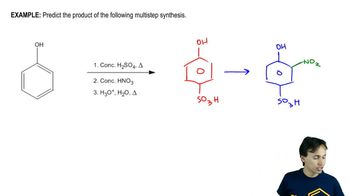
Multistep Synthesis

Reaction Mechanisms

A reaction mechanism describes the step-by-step process by which reactants are converted into products. It includes details about bond breaking and forming, intermediates, and transition states. Familiarity with common mechanisms, such as SN1, SN2, E1, and E2, is essential for predicting products in organic reactions.
Video consigliato:
02:16
Heck Reaction Mechanism

Functional Group Transformations

Functional group transformations refer to the chemical changes that occur to specific groups within a molecule, altering its reactivity and properties. Recognizing how different functional groups react under various conditions allows chemists to anticipate the products of multistep reactions. This knowledge is vital for synthesizing complex organic compounds.
Video consigliato:
02:36
Identifying Functional Groups