Ch. 24 - Benzene 2: Reactions Influenced by the Aromatic Ring
Mullins - Organic Chemistry: A Learner Centered Approach 1st Edition
Mullins1st EditionOrganic Chemistry: A Learner Centered ApproachISBN: 9780137566471Non è quello che usi tu?Cambia libro di testo
Capitolo 23, Problema 5

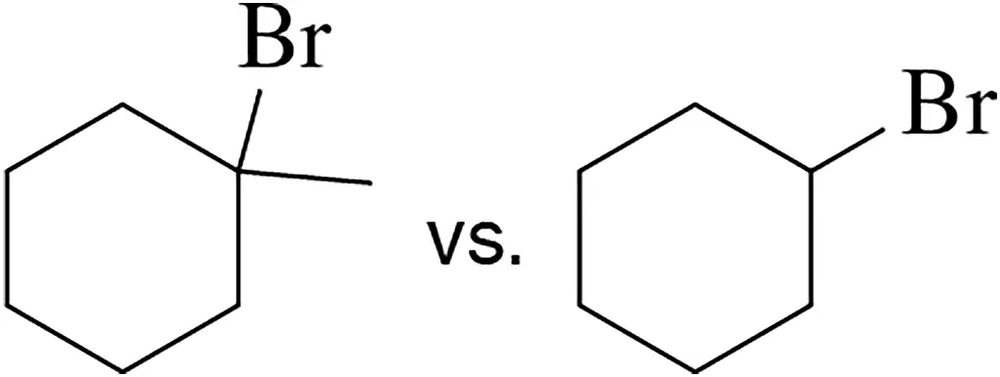
Which haloalkane would you expect to undergo the fastest SN1 reaction? Why?
Comparison of two haloalkane structures with bromine, highlighting differences in SN1 reaction rates.

Guida verificata passo dopo passo
1
Understand the SN1 reaction mechanism: The SN1 reaction is a two-step process where the rate-determining step is the formation of a carbocation intermediate. The stability of this carbocation is crucial in determining the reaction rate.
Identify the factors that stabilize carbocations: Carbocations are stabilized by electron-donating groups, hyperconjugation, and resonance. Tertiary carbocations are more stable than secondary, which are more stable than primary, due to the inductive and hyperconjugative effects of alkyl groups.
Consider the structure of the haloalkane: A tertiary haloalkane will form a tertiary carbocation upon loss of the leaving group, making it the most favorable for an SN1 reaction. Secondary haloalkanes are less favorable, and primary haloalkanes are the least favorable.
Evaluate the leaving group: A good leaving group (e.g., I-, Br-, Cl-) facilitates the formation of the carbocation. The better the leaving group, the faster the reaction proceeds.
Combine the factors: The haloalkane with a tertiary carbon attached to the halogen and the best leaving group will undergo the fastest SN1 reaction. Analyze the given haloalkanes based on these criteria to determine the fastest-reacting one.

Risposta video verificata per un problema simile:

Questa soluzione video è stata consigliata dai nostri tutor come utile per risolvere questo problema.
Durata del video:
2m

Concetti chiave

Ecco i concetti essenziali che devi comprendere per rispondere correttamente alla domanda.

S_N 1 Mechanism

The S_N 1 mechanism, or unimolecular nucleophilic substitution, involves two main steps: the formation of a carbocation intermediate and the subsequent attack by a nucleophile. The rate of the reaction depends solely on the concentration of the substrate, as the nucleophile does not participate in the rate-determining step. This mechanism is favored in polar protic solvents and typically occurs with tertiary haloalkanes due to their ability to stabilize the carbocation.
Video consigliato:
04:32
General Mechanism

Carbocation Stability

Carbocation stability is a crucial factor in S_N 1 reactions, as more stable carbocations form more readily and lead to faster reactions. Stability increases with the degree of substitution: tertiary carbocations are more stable than secondary, which are more stable than primary. This stability is influenced by hyperconjugation and inductive effects from surrounding alkyl groups, making tertiary haloalkanes the most favorable substrates for S_N 1 reactions.
Video consigliato:
05:58
Determining Carbocation Stability

Haloalkane Structure

The structure of haloalkanes, which are organic compounds containing carbon, hydrogen, and halogen atoms, significantly impacts their reactivity in S_N 1 reactions. The presence of bulky groups around the carbon bonded to the halogen can hinder or facilitate the formation of the carbocation. Tertiary haloalkanes, with three alkyl groups attached to the carbon, provide steric hindrance that stabilizes the carbocation, making them more likely to undergo rapid S_N 1 reactions compared to primary or secondary haloalkanes.

Video consigliato:
03:04
Drawing Resonance Structures