Ch. 27 - Carbohydrates, Nucleic Acids, and Lipids
Mullins - Organic Chemistry: A Learner Centered Approach 1st Edition
Mullins1st EditionOrganic Chemistry: A Learner Centered ApproachISBN: 9780137566471Non è quello che usi tu?Cambia libro di testo
Capitolo 26, Problema 59b

Identify the product when each of the following reactions is performed on the triglyceride of linoleic acid (linoleate).

(b) H2 , Ni (partial hydrogenation)

Guida verificata passo dopo passo
1
Step 1: Analyze the structure of linoleate triglyceride. It consists of a glycerol backbone esterified with three fatty acid chains, each containing two double bonds in a cis configuration.
Step 2: Understand the reaction conditions. Partial hydrogenation involves the addition of hydrogen (H₂) in the presence of a nickel (Ni) catalyst, which selectively reduces some of the double bonds in the fatty acid chains.
Step 3: Predict the effect of partial hydrogenation. Under these conditions, one or more of the double bonds in the fatty acid chains may be converted to single bonds, resulting in a mixture of saturated and unsaturated fatty acids. The cis configuration of the double bonds may also be converted to trans configuration in some cases.
Step 4: Consider the product structure. After partial hydrogenation, the triglyceride will have fewer double bonds, and some of the double bonds may be converted to trans isomers. The exact product depends on the extent of hydrogenation and the selectivity of the catalyst.
Step 5: Note the implications. Partial hydrogenation is commonly used in the food industry to produce semi-solid fats, but it can lead to the formation of trans fats, which are associated with health risks.

Risposta video verificata per un problema simile:

Questa soluzione video è stata consigliata dai nostri tutor come utile per risolvere questo problema.

Concetti chiave

Ecco i concetti essenziali che devi comprendere per rispondere correttamente alla domanda.

Triglycerides

Triglycerides are esters formed from glycerol and three fatty acids. They are the main constituents of body fat in humans and animals, as well as vegetable fat. In the case of linoleic acid, a polyunsaturated fatty acid, its triglyceride form can undergo various chemical reactions, including hydrogenation, which alters its saturation level.
Video consigliato:
Percorso guidato
0:57
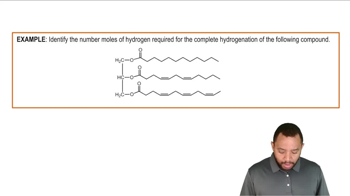
Triacylglycerol Reactions: Hydrogenation Example 1

Partial Hydrogenation

Partial hydrogenation is a chemical process that adds hydrogen to unsaturated fats, converting some double bonds into single bonds. This process can increase the stability and shelf life of oils but may also lead to the formation of trans fats. In the context of linoleate, partial hydrogenation will convert some of its double bonds, resulting in a product with fewer unsaturated sites.
Video consigliato:
Percorso guidato
1:19
Peptide Sequencing: Partial Hydrolysis Concept 1

Linoleic Acid

Linoleic acid is an essential polyunsaturated fatty acid that is crucial for human health. It contains two double bonds and is classified as an omega-6 fatty acid. Understanding its structure and properties is vital for predicting the outcomes of chemical reactions, such as hydrogenation, which can affect its nutritional value and physical characteristics.
Video consigliato:
Percorso guidato
1:59
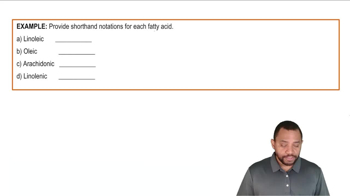
Fatty Acids Example 5