Ch. 3 - Alkanes and Cycloalkanes: Properties and Conformational Analysis
Mullins - Organic Chemistry: A Learner Centered Approach 1st Edition
Mullins1st EditionOrganic Chemistry: A Learner Centered ApproachISBN: 9780137566471Non è quello che usi tu?Cambia libro di testo
Capitolo 2, Problema 33

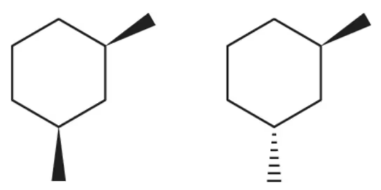
Name the following cycloalkanes using the IUPAC system of nomenclature.

Guida verificata passo dopo passo
1
Step 1: Identify the parent chain. In both structures, the parent chain is a cyclohexane ring, as it is the largest cyclic structure present.
Step 2: Determine the substituents attached to the cyclohexane ring. In the first structure, there are two substituents: one wedge-shaped group and one dash-shaped group. In the second structure, there is one wedge-shaped group and one dash-shaped group as well.
Step 3: Assign locants (numbers) to the substituents to minimize the numbering. Start numbering the ring from the position closest to the substituents, ensuring the lowest possible locants are assigned.
Step 4: Specify the stereochemistry of the substituents. The wedge indicates a substituent coming out of the plane (towards the observer), while the dash indicates a substituent going into the plane (away from the observer). Use the terms 'cis' or 'trans' to describe the relative positions of the substituents.
Step 5: Combine the information into the IUPAC name. Include the parent chain, locants, substituents, and stereochemistry in the name, ensuring proper order and formatting.

Risposta video verificata per un problema simile:

Questa soluzione video è stata consigliata dai nostri tutor come utile per risolvere questo problema.

Concetti chiave

Ecco i concetti essenziali che devi comprendere per rispondere correttamente alla domanda.

Cycloalkanes

Cycloalkanes are saturated hydrocarbons that contain carbon atoms arranged in a ring structure. They follow the general formula CnH2n, where n is the number of carbon atoms. Understanding the structure of cycloalkanes is essential for naming them correctly, as the ring can influence the compound's properties and reactivity.
Video consigliato:
01:11
How to find the root name for cycloalkanes

IUPAC Nomenclature

The International Union of Pure and Applied Chemistry (IUPAC) nomenclature provides a systematic method for naming chemical compounds. For cycloalkanes, the naming involves identifying the number of carbon atoms in the ring, using prefixes like 'cyclo-' followed by the appropriate alkane name. This standardized approach ensures that each compound has a unique and universally accepted name.
Video consigliato:
03:43
The different parts of an IUPAC name

Substituents and Ring Size

When naming cycloalkanes, it is crucial to consider any substituents attached to the ring and the size of the ring itself. Substituents are groups of atoms that replace hydrogen atoms in the cycloalkane, and their positions are indicated by numbering the carbon atoms in the ring. The size of the ring can also affect the stability and reactivity of the compound, influencing how it is named.
Video consigliato:
05:14
Ring Expansion