Ch. 4 - Acids and Bases/Electron Flow
Mullins - Organic Chemistry: A Learner Centered Approach 1st Edition
Mullins1st EditionOrganic Chemistry: A Learner Centered ApproachISBN: 9780137566471Non è quello che usi tu?Cambia libro di testo
Capitolo 3, Problema 62h(iii, iv)

For the following acid–base pairs, (iii) predict the favored side of equilibrium; (iv) calculate Keq;
(h) Chemical equation showing the equilibrium between ammonia and hydrochloric acid.

Guida verificata passo dopo passo
1
Step 1: Identify the acid and base on both sides of the equilibrium. In this reaction, NH₃ acts as a base and HCl acts as an acid. The products formed are NH₄⁺ (conjugate acid of NH₃) and Cl⁻ (conjugate base of HCl).
Step 2: Compare the relative strengths of the acids and bases involved. HCl is a strong acid, while NH₄⁺ is a weak acid. Similarly, NH₃ is a weak base, and Cl⁻ is a very weak base.
Step 3: Predict the favored side of the equilibrium. Since the reaction involves a strong acid (HCl) reacting with a weak base (NH₃), the equilibrium will favor the formation of the weaker acid and base, which are NH₄⁺ and Cl⁻.
Step 4: Use the pKa values to calculate the equilibrium constant (Keq). The relationship between Keq and pKa is given by the formula: Keq=10(pKaacid-pKaconjugate acid). Look up the pKa values for HCl and NH₄⁺ to perform this calculation.
Step 5: Interpret the result. A large Keq value indicates that the equilibrium strongly favors the products (NH₄⁺ and Cl⁻), while a small Keq value would indicate that the reactants (NH₃ and HCl) are favored.

Risposta video verificata per un problema simile:

Questa soluzione video è stata consigliata dai nostri tutor come utile per risolvere questo problema.
Durata del video:
1m

Concetti chiave

Ecco i concetti essenziali che devi comprendere per rispondere correttamente alla domanda.

Acid-Base Equilibrium

Acid-base equilibrium refers to the state in which the rates of the forward and reverse reactions of an acid-base reaction are equal, resulting in constant concentrations of reactants and products. The position of equilibrium can be predicted based on the strength of the acids and bases involved, with stronger acids favoring the formation of weaker acids and vice versa.
Video consigliato:
04:00
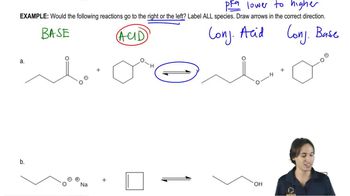
Determining Acid/Base Equilibrium

Equilibrium Constant (K_eq)

The equilibrium constant (K_eq) quantifies the ratio of the concentrations of products to reactants at equilibrium for a given reaction at a specific temperature. A large K_eq value, such as 1.0 x 10^47, indicates that the products are favored at equilibrium, suggesting that the reaction proceeds almost to completion, while a small K_eq value would indicate that reactants are favored.
Video consigliato:
02:19
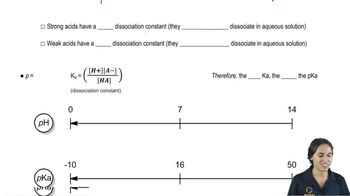
The relationship between equilibrium constant and pKa.

Strength of Acids and Bases

The strength of acids and bases is determined by their ability to donate or accept protons (H+ ions). Strong acids, like HBr, completely dissociate in solution, while weak acids do not. Similarly, strong bases readily accept protons, while weak bases do so less effectively. Understanding the relative strengths of the acids and bases involved is crucial for predicting the favored side of the equilibrium.
Video consigliato:
Percorso guidato
2:50
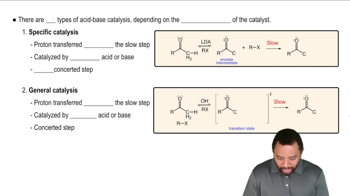
Acid-Base Catalysis Concept 3