Ch. 4 - Acids and Bases/Electron Flow
Mullins - Organic Chemistry: A Learner Centered Approach 1st Edition
Mullins1st EditionOrganic Chemistry: A Learner Centered ApproachISBN: 9780137566471Non è quello che usi tu?Cambia libro di testo
Capitolo 3, Problema 62f(v, vi)

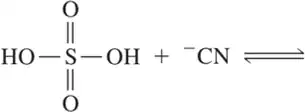
For the following acid–base pairs, (v) show a mechanism for the reaction; and (vi) draw a reaction coordinate diagram.
(f) Chemical equation illustrating the reaction between a sulfonic acid and a cyanide ion.

Guida verificata passo dopo passo
1
Step 1: Identify the acid and base in the given acid-base pair. The acid is the species that donates a proton (H⁺), and the base is the species that accepts the proton. Write down their chemical structures.
Step 2: Write the mechanism for the reaction. Use curved arrows to show the movement of electrons. Specifically, show the base attacking the proton (H⁺) of the acid, and the bond between the proton and the acid breaking to form the conjugate base.
Step 3: Draw the products of the reaction. The acid will lose a proton and become its conjugate base, while the base will gain a proton and become its conjugate acid.
Step 4: Construct a reaction coordinate diagram. Label the axes: the x-axis represents the reaction progress, and the y-axis represents the energy. Indicate the energy levels of the reactants, the transition state, and the products. Show the activation energy (Ea) and the overall energy change (ΔE).
Step 5: Analyze the reaction coordinate diagram. Discuss whether the reaction is exergonic (energy-releasing) or endergonic (energy-absorbing) based on the relative energy levels of the reactants and products.

Risposta video verificata per un problema simile:

Questa soluzione video è stata consigliata dai nostri tutor come utile per risolvere questo problema.
Durata del video:
4m

Concetti chiave

Ecco i concetti essenziali che devi comprendere per rispondere correttamente alla domanda.

Acid-Base Theory

Acid-base theory explains the behavior of acids and bases in chemical reactions. According to the Brønsted-Lowry theory, acids are proton donors while bases are proton acceptors. Understanding this concept is crucial for predicting the direction of acid-base reactions and identifying the conjugate acid-base pairs involved.
Video consigliato:
02:49
The Lewis definition of acids and bases.

Reaction Mechanism

A reaction mechanism details the step-by-step process by which reactants transform into products. It includes the breaking and forming of bonds, the movement of electrons, and the intermediates formed during the reaction. Illustrating a mechanism helps clarify how the acid-base reaction occurs at a molecular level.
Video consigliato:
02:16
Heck Reaction Mechanism

Reaction Coordinate Diagram

A reaction coordinate diagram visually represents the energy changes during a chemical reaction. It plots the energy of the system against the progress of the reaction, showing the transition states and intermediates. This diagram is essential for understanding the energy barriers and the overall thermodynamics of the acid-base reaction.
Video consigliato:
05:02
Coordination Complexes