Ch. 4 - Acids and Bases/Electron Flow
Mullins - Organic Chemistry: A Learner Centered Approach 1st Edition
Mullins1st EditionOrganic Chemistry: A Learner Centered ApproachISBN: 9780137566471Non è quello che usi tu?Cambia libro di testo
Capitolo 3, Problema 20c(iv,v)

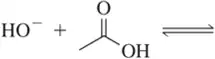
In the following reactions,
(iv) provide an arrow-pushing mechanism of the proton transfer that will occur, and
(v) predict the product of the reactions. [You'll need to provide the lone pairs here.]
(c) Chemical reaction showing hydroxide ion reacting with a carbonyl compound, illustrating acid-base interactions.

Guida verificata passo dopo passo
1
Step 1: Identify the reactants and their roles in the proton transfer. Ethanolate (CH3CH2O⁻) is a strong base due to its negatively charged oxygen atom, which has lone pairs of electrons. Acetic acid (CH3COOH) is a weak acid, capable of donating a proton (H⁺) from its hydroxyl group (-OH).
Step 2: Recognize the site of interaction. The negatively charged oxygen atom in ethanolate will act as a nucleophile and attack the hydrogen atom of the hydroxyl group (-OH) in acetic acid. This is the proton transfer step.
Step 3: Draw the arrow-pushing mechanism. Use curved arrows to show the movement of electrons: (i) A lone pair of electrons on the oxygen atom of ethanolate attacks the hydrogen atom of acetic acid, forming a bond. (ii) Simultaneously, the bond between the hydrogen and oxygen in acetic acid breaks, and the electrons move to the oxygen atom of acetic acid, creating an acetate ion (CH3COO⁻).
Step 4: Predict the products of the reaction. The proton transfer results in the formation of ethanol (CH3CH2OH) and acetate ion (CH3COO⁻). Ethanol is formed as the ethanolate gains a proton, and acetate ion is formed as acetic acid loses a proton.
Step 5: Verify the stability of the products. Ethanol is neutral and stable, while acetate ion is resonance-stabilized due to the delocalization of electrons between the two oxygen atoms in the carboxylate group. This makes the reaction thermodynamically favorable.

Risposta video verificata per un problema simile:

Questa soluzione video è stata consigliata dai nostri tutor come utile per risolvere questo problema.
Durata del video:
2m

Concetti chiave

Ecco i concetti essenziali che devi comprendere per rispondere correttamente alla domanda.

Proton Transfer Mechanism

Proton transfer mechanisms involve the movement of a proton (H+) from one molecule to another, often facilitated by the presence of a base or acid. In this case, ethanolate acts as a base, accepting a proton from acetic acid. Understanding the arrow-pushing notation is crucial, as it visually represents the flow of electrons during the reaction, indicating how bonds are formed and broken.
Video consigliato:
Percorso guidato
3:05
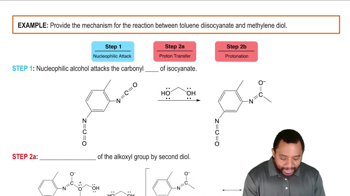
Polyurethane Mechanism Example 1

Acid-Base Reactions

Acid-base reactions are fundamental in organic chemistry, characterized by the transfer of protons between reactants. Acetic acid, a weak acid, donates a proton to the ethanolate ion, which is a strong base. Recognizing the strength of acids and bases helps predict the direction of the reaction and the stability of the resulting products.
Video consigliato:
02:49
The Lewis definition of acids and bases.

Lone Pairs and Bond Formation

Lone pairs are pairs of valence electrons that are not involved in bonding and can play a significant role in chemical reactions. In the context of the given reaction, the lone pair on the ethanolate ion is used to form a bond with the proton from acetic acid. Understanding how lone pairs participate in bond formation is essential for predicting the products of reactions and the overall mechanism.
Video consigliato:
02:04
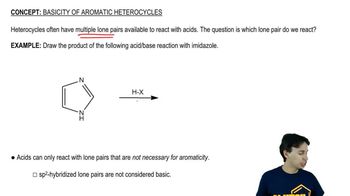
Heterocycles - Which lone pairs react?