Ch. 4 - Acids and Bases/Electron Flow
Mullins - Organic Chemistry: A Learner Centered Approach 1st Edition
Mullins1st EditionOrganic Chemistry: A Learner Centered ApproachISBN: 9780137566471Non è quello che usi tu?Cambia libro di testo
Capitolo 3, Problema 7a

Sodium amide (NaNH2) dissociates to give a sodium cation (Na+) and amide ion (NH2-) a very strong base. In the following three equations, identify which definition of base is being exemplified.
(a) Chemical equation showing sodium amide dissociation into sodium cation and amide ion, illustrating base definitions.

Guida verificata passo dopo passo
1
Step 1: Recall the three main definitions of a base in chemistry: (1) Arrhenius base - a substance that increases the concentration of OH⁻ ions in aqueous solution, (2) Brønsted-Lowry base - a substance that accepts a proton (H⁺), and (3) Lewis base - a substance that donates a pair of electrons.
Step 2: Analyze the dissociation of sodium amide (NaNH₂). When NaNH₂ dissociates, it forms Na⁺ and NH₂⁻. The NH₂⁻ ion is a strong base. Determine which definition of a base applies to this behavior.
Step 3: For each equation provided, examine the role of NH₂⁻. If NH₂⁻ is accepting a proton (H⁺), it is acting as a Brønsted-Lowry base. If NH₂⁻ is donating a pair of electrons to form a bond, it is acting as a Lewis base.
Step 4: For equation (a), identify whether NH₂⁻ is increasing the concentration of OH⁻ ions in solution (Arrhenius base), accepting a proton (Brønsted-Lowry base), or donating an electron pair (Lewis base).
Step 5: Match the behavior of NH₂⁻ in equation (a) to the appropriate base definition and repeat this process for the other equations to identify the base definition being exemplified in each case.

Risposta video verificata per un problema simile:

Questa soluzione video è stata consigliata dai nostri tutor come utile per risolvere questo problema.
Durata del video:
3m

Concetti chiave

Ecco i concetti essenziali che devi comprendere per rispondere correttamente alla domanda.

Brønsted-Lowry Base

A Brønsted-Lowry base is defined as a substance that can accept protons (H⁺ ions) in a chemical reaction. In the context of sodium amide, the amide ion (NH₂⁻) acts as a Brønsted-Lowry base by accepting protons from acids, thereby facilitating various acid-base reactions.
Video consigliato:
00:54
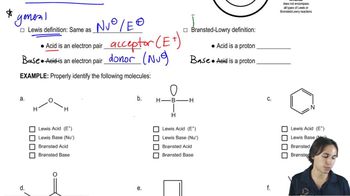
The Bronsted-Lowry definition of acids and bases.

Lewis Base

A Lewis base is defined as an electron pair donor in a chemical reaction. Sodium amide's amide ion can donate a pair of electrons to form a bond with a Lewis acid, demonstrating its behavior as a Lewis base. This concept broadens the understanding of basicity beyond proton transfer.
Video consigliato:
02:49
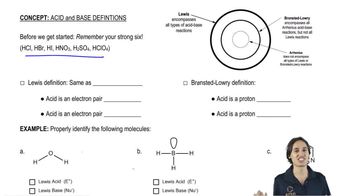
The Lewis definition of acids and bases.

Strong Base

A strong base is a substance that completely dissociates in solution to produce hydroxide ions (OH⁻) or other strong basic ions. Sodium amide is classified as a strong base because it dissociates fully in solution, resulting in the formation of the highly reactive amide ion, which can readily deprotonate weak acids.
Video consigliato:
03:10
Monosaccharides - Strong Oxidation (Aldaric Acid)