Ch. 4 - Acids and Bases/Electron Flow
Mullins - Organic Chemistry: A Learner Centered Approach 1st Edition
Mullins1st EditionOrganic Chemistry: A Learner Centered ApproachISBN: 9780137566471Non è quello che usi tu?Cambia libro di testo
Capitolo 3, Problema 73c

Suggest an arrow-pushing mechanism for each of the following acid–base reactions
(c) Chemical reaction showing an arrow-pushing mechanism between a cyanide ion and an aldehyde, resulting in a new compound.

Guida verificata passo dopo passo
1
Identify the acid and base in the reaction. The acid is the species donating a proton (H⁺), and the base is the species accepting the proton.
Draw the Lewis structures of the acid and base to visualize the electron pairs involved in the reaction. Highlight the lone pair on the base that will interact with the proton from the acid.
Use curved arrows to represent the movement of electrons. Start the arrow at the lone pair of the base and point it toward the hydrogen atom of the acid, indicating the formation of a bond between the base and the proton.
Show the breaking of the bond between the hydrogen atom and the atom it was originally attached to in the acid. Use a curved arrow starting at the bond and pointing toward the atom that will retain the electrons after the bond breaks.
Verify the products of the reaction. The base becomes protonated, forming its conjugate acid, and the acid loses a proton, forming its conjugate base. Ensure that charges and electron counts are balanced in the final structures.

Risposta video verificata per un problema simile:

Questa soluzione video è stata consigliata dai nostri tutor come utile per risolvere questo problema.
Durata del video:
2m

Concetti chiave

Ecco i concetti essenziali che devi comprendere per rispondere correttamente alla domanda.

Acid-Base Theory

Acid-base theory explains the behavior of acids and bases in chemical reactions. According to the Brønsted-Lowry theory, acids are proton donors while bases are proton acceptors. Understanding this concept is crucial for predicting the direction of acid-base reactions and the formation of conjugate acids and bases.
Video consigliato:
02:49
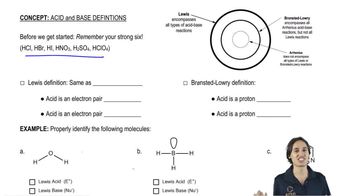
The Lewis definition of acids and bases.

Arrow-Pushing Mechanism

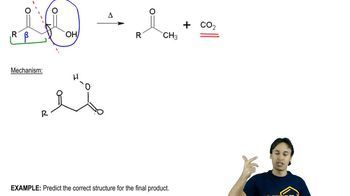
Arrow-pushing mechanisms are a way to illustrate the movement of electrons during chemical reactions. In these diagrams, arrows represent the flow of electron pairs, indicating how bonds are formed or broken. This visual representation helps in understanding the stepwise progression of reactions, particularly in acid-base interactions.
Video consigliato:
04:32
General Mechanism

Conjugate Acid-Base Pairs

Conjugate acid-base pairs are related species that differ by the presence of a proton. When an acid donates a proton, it forms its conjugate base, while the base that accepts the proton becomes its conjugate acid. Recognizing these pairs is essential for analyzing the equilibrium of acid-base reactions and predicting the products formed.
Video consigliato:
Percorso guidato
2:56
Base Pairing Concept 1