Ch. 5 - Chemical Reaction Analysis: Thermodynamics and Kinetics
Mullins - Organic Chemistry: A Learner Centered Approach 1st Edition
Mullins1st EditionOrganic Chemistry: A Learner Centered ApproachISBN: 9780137566471Non è quello che usi tu?Cambia libro di testo
Capitolo 4, Problema 32

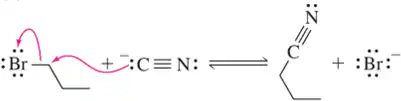
Assuming that ∆H° = -15kcal/mol for the reaction in Assessment 5.31(b), show the transition state for the forward and reverse reactions.
Diagram illustrating the transition state for a reaction with a nitrogen triple bond and bromine, showing electron movement.

Guida verificata passo dopo passo
1
Understand the problem: The question involves analyzing the transition state for both the forward and reverse reactions. The given enthalpy change (∆H° = -15 kcal/mol) indicates that the reaction is exothermic, meaning the products are lower in energy than the reactants.
Draw the energy diagram: Sketch an energy profile for the reaction. The y-axis represents energy, and the x-axis represents the reaction coordinate. Label the reactants, products, and the transition state. Since the reaction is exothermic, the products will be at a lower energy level than the reactants.
Identify the transition state: The transition state is the highest energy point along the reaction coordinate. It represents the energy barrier that must be overcome for the reaction to proceed. Label this point on the energy diagram as the transition state (TS).
Determine the activation energy: For the forward reaction, the activation energy (Ea_forward) is the energy difference between the reactants and the transition state. For the reverse reaction, the activation energy (Ea_reverse) is the energy difference between the products and the transition state. Use the relationship: Ea_reverse = Ea_forward - ∆H°.
Label the diagram: Clearly label the activation energies (Ea_forward and Ea_reverse), the transition state, and the enthalpy change (∆H°) on the energy diagram. This will visually represent the energy changes and the transition state for both the forward and reverse reactions.

Risposta video verificata per un problema simile:

Questa soluzione video è stata consigliata dai nostri tutor come utile per risolvere questo problema.
Durata del video:
5m

Concetti chiave

Ecco i concetti essenziali che devi comprendere per rispondere correttamente alla domanda.

Transition State Theory

Transition State Theory posits that during a chemical reaction, reactants pass through a high-energy transition state before forming products. This state represents the point of maximum energy along the reaction pathway, where bonds are partially broken and formed. Understanding this concept is crucial for visualizing how reactants transform into products and for analyzing reaction mechanisms.
Video consigliato:
06:55
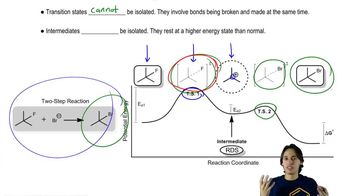
Intermediates vs. Transition States

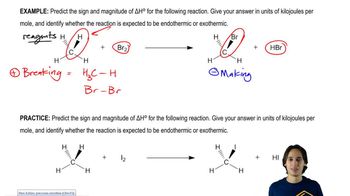
Enthalpy Change (∆H°)

Enthalpy change (∆H°) is a measure of the heat content of a system at constant pressure. A negative ∆H° indicates that the reaction is exothermic, meaning it releases energy to the surroundings. This concept is essential for understanding the energy profile of a reaction, including the stability of the transition state and the relative energies of reactants and products.
Video consigliato:
04:38
Calculating Enthalpies

Reaction Coordinate Diagram

A reaction coordinate diagram is a graphical representation that illustrates the energy changes during a chemical reaction as it progresses from reactants to products. It typically shows the energy of the system on the y-axis and the reaction progress on the x-axis, highlighting the transition state and the energy barriers for both the forward and reverse reactions. This diagram is vital for visualizing the relationship between the transition state and the overall reaction energetics.
Video consigliato:
05:02
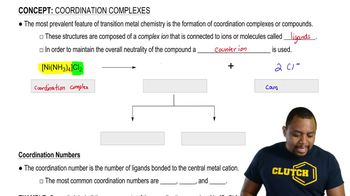
Coordination Complexes