Ch. 5 - Chemical Reaction Analysis: Thermodynamics and Kinetics
Mullins - Organic Chemistry: A Learner Centered Approach 1st Edition
Mullins1st EditionOrganic Chemistry: A Learner Centered ApproachISBN: 9780137566471Non è quello che usi tu?Cambia libro di testo
Capitolo 4, Problema 12a

At what temperature does the entropy change of a process not contribute to the favorability of a process?

Guida verificata passo dopo passo
1
Understand the relationship between Gibbs free energy (ΔG), enthalpy change (ΔH), entropy change (ΔS), and temperature (T) using the equation ΔG = ΔH - TΔS.
Recognize that the entropy change (ΔS) does not contribute to the favorability of a process when the term TΔS becomes zero. This happens when T = 0 Kelvin.
Recall that at absolute zero (0 Kelvin), molecular motion ceases, and entropy is at its minimum value, meaning entropy change does not influence the process.
Consider the practical implications: While this is a theoretical concept, real-world processes do not occur at 0 Kelvin due to the third law of thermodynamics, which states that absolute zero is unattainable.
Conclude that the temperature at which entropy change does not contribute to favorability is 0 Kelvin, but this is a theoretical limit rather than a practical condition.

Risposta video verificata per un problema simile:

Questa soluzione video è stata consigliata dai nostri tutor come utile per risolvere questo problema.
Durata del video:
1m

Concetti chiave

Ecco i concetti essenziali che devi comprendere per rispondere correttamente alla domanda.

Entropy

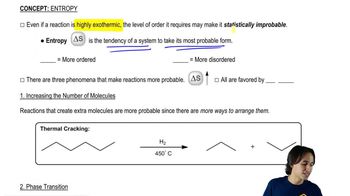
Entropy is a measure of the disorder or randomness in a system. In thermodynamics, it quantifies the number of ways a system can be arranged, with higher entropy indicating greater disorder. Entropy changes during a process can influence its spontaneity, as systems tend to evolve towards states of higher entropy.
Video consigliato:
02:46
Explaining what entropy is.

Gibbs Free Energy

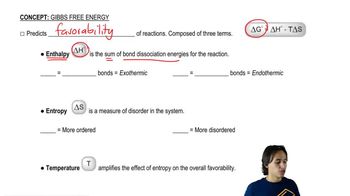
Gibbs Free Energy (G) is a thermodynamic potential that helps predict the favorability of a process at constant temperature and pressure. The change in Gibbs Free Energy (ΔG) is calculated using the equation ΔG = ΔH - TΔS, where ΔH is the change in enthalpy, T is the temperature in Kelvin, and ΔS is the change in entropy. A process is spontaneous when ΔG is negative.
Video consigliato:
05:02
Breaking down the different terms of the Gibbs Free Energy equation.

Temperature's Role in Entropy and Favorability

Temperature plays a crucial role in determining the impact of entropy on the favorability of a process. At absolute zero (0 K), the entropy change becomes negligible, and thus, the contribution of entropy to the Gibbs Free Energy equation is minimal. As temperature increases, the influence of entropy on spontaneity becomes more significant, particularly when ΔS is positive.
Video consigliato:
02:46
Explaining what entropy is.