Ch. 5 - Chemical Reaction Analysis: Thermodynamics and Kinetics
Mullins - Organic Chemistry: A Learner Centered Approach 1st Edition
Mullins1st EditionOrganic Chemistry: A Learner Centered ApproachISBN: 9780137566471Non è quello che usi tu?Cambia libro di testo
Capitolo 4, Problema 18d

For each of the following processes, indicate whether you expect ∆S° to be greater than, less than, or equal to 0. Explain your answer.
(d) Chemical reaction showing the conversion of a brominated compound with sodium ethoxide to form an alkene, ethanol, and sodium bromide.

Guida verificata passo dopo passo
1
Step 1: Analyze the reaction provided in the image. The reaction involves the elimination of HBr from 2-bromopropane using sodium ethoxide (NaOEt) as the base, resulting in the formation of propene, ethanol (EtOH), and sodium bromide (NaBr).
Step 2: Consider the change in the number of molecules during the reaction. The reactants include 2-bromopropane and NaOEt (2 molecules), while the products include propene, EtOH, and NaBr (3 molecules). Since the number of molecules increases, this suggests an increase in entropy (∆S° > 0).
Step 3: Evaluate the physical states of the reactants and products. All species involved are in the liquid phase, so the change in entropy is primarily due to the increase in the number of molecules rather than a change in physical state.
Step 4: Consider the structural changes. The reactants are more ordered (a single alkyl halide and a base), while the products include a gaseous alkene (propene), which contributes to greater disorder and an increase in entropy.
Step 5: Conclude that ∆S° is expected to be greater than 0 for this reaction, as the number of molecules increases and the formation of a gaseous product contributes to increased disorder.

Risposta video verificata per un problema simile:

Questa soluzione video è stata consigliata dai nostri tutor come utile per risolvere questo problema.

Concetti chiave

Ecco i concetti essenziali che devi comprendere per rispondere correttamente alla domanda.

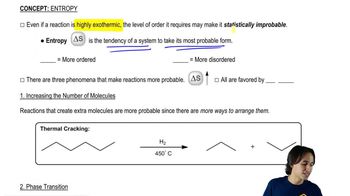
Entropy (∆S°)

Entropy, denoted as ∆S°, is a measure of the disorder or randomness in a system. In thermodynamics, a positive change in entropy (∆S° > 0) indicates an increase in disorder, while a negative change (∆S° < 0) suggests a decrease in disorder. Understanding how molecular arrangements and states of matter affect entropy is crucial for predicting the sign of ∆S° in various processes.
Video consigliato:
02:46
Explaining what entropy is.

Phase Changes

Phase changes, such as melting, boiling, or sublimation, significantly influence entropy. For example, when a solid melts into a liquid, the molecules become more disordered, leading to an increase in entropy (∆S° > 0). Conversely, when a gas condenses into a liquid, the system becomes more ordered, resulting in a decrease in entropy (∆S° < 0). Recognizing these changes helps in assessing the expected sign of ∆S°.
Video consigliato:
Percorso guidato
1:53
Merrifield Solid-Phase Peptide Synthesis Concept 1

Molecular Complexity

The complexity of molecules also affects entropy. More complex molecules with greater numbers of atoms and bonds typically have higher entropy due to the increased number of possible arrangements. When comparing reactions or processes involving simple versus complex molecules, understanding how molecular structure impacts disorder is essential for predicting whether ∆S° will be greater than, less than, or equal to zero.
Video consigliato:
05:02
Coordination Complexes