Ch. 5 - Chemical Reaction Analysis: Thermodynamics and Kinetics
Mullins - Organic Chemistry: A Learner Centered Approach 1st Edition
Mullins1st EditionOrganic Chemistry: A Learner Centered ApproachISBN: 9780137566471Non è quello che usi tu?Cambia libro di testo
Capitolo 4, Problema 51b

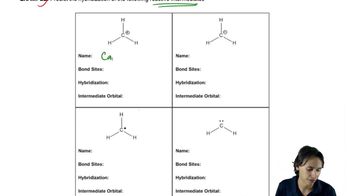
For each set of reactive intermediates, rank them in order of reactivity (1 = most reactive).
(b) Structural representations of reactive intermediates for ranking their reactivity in radical reactions.

Guida verificata passo dopo passo
1
Step 1: Identify the reactive intermediates shown in the image. These include radicals, carbocations, and carbanions. Each structure has a specific type of reactive intermediate based on the presence of a lone electron, positive charge, or negative charge.
Step 2: Understand the factors that influence the stability and reactivity of these intermediates. For radicals, carbocations, and carbanions, stability is influenced by factors such as hyperconjugation, resonance, and inductive effects. Generally, more stable intermediates are less reactive.
Step 3: Analyze the structures provided. Look for stabilizing features such as alkyl groups (which provide hyperconjugation and inductive effects), resonance stabilization (delocalization of charge or lone electron), and whether the intermediate is primary, secondary, or tertiary.
Step 4: Rank the intermediates based on their stability. For example, tertiary carbocations are more stable than secondary or primary carbocations due to greater hyperconjugation and inductive effects. Similarly, radicals and carbanions follow similar trends in stability.
Step 5: Assign the reactivity ranking (1 = most reactive) based on the inverse relationship between stability and reactivity. The least stable intermediate will be the most reactive, and the most stable intermediate will be the least reactive.

Risposta video verificata per un problema simile:

Questa soluzione video è stata consigliata dai nostri tutor come utile per risolvere questo problema.
Durata del video:
3m

Concetti chiave

Ecco i concetti essenziali che devi comprendere per rispondere correttamente alla domanda.

Reactive Intermediates

Reactive intermediates are transient species that form during the course of a chemical reaction. They include carbocations, carbanions, and free radicals, each with distinct stability and reactivity. Understanding their structure and stability is crucial, as more stable intermediates are generally less reactive, while less stable ones are more reactive.
Video consigliato:
02:47
Introduction to the reactive intermediates.

Stability of Intermediates

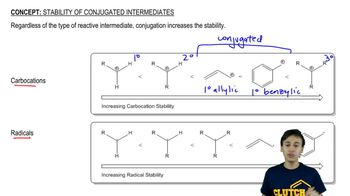
The stability of reactive intermediates is influenced by factors such as hybridization, resonance, and inductive effects. For example, tertiary carbocations are more stable than primary ones due to hyperconjugation and inductive effects from surrounding alkyl groups. Recognizing these stability trends helps in predicting the reactivity of different intermediates.
Video consigliato:
04:31
Stability of Conjugated Intermediates

Reactivity Trends

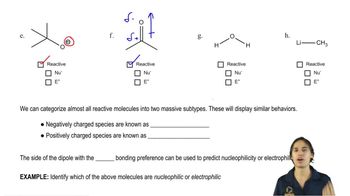
Reactivity trends in organic chemistry often follow the principle that less stable intermediates are more reactive. This is due to their higher energy state, which drives them to react quickly to achieve a more stable configuration. Understanding these trends allows chemists to rank intermediates based on their expected reactivity in a given reaction.
Video consigliato:
01:17
Reactivity of Molecules
Pratica correlata
Domanda del libro di testo

For each set of reactive intermediates, rank them in order of reactivity (1 = most reactive).

(a)

1056
views

Domanda del libro di testo

The A value of a substituent on a cyclohexane ring is essentially the ∆G° for a substituent going from the equatorial to the axial position in a chair–chair interconversion. Because most substituents prefer to be in the equatorial position, A values are, by definition, positive numbers. Use the table of A values to calculate ∆G° and Keq for the chair–chair interconversions shown.

(c)

1262
views
Domanda del libro di testo

Predict the product(s) of the following halogenation reactions. Only one equivalent of the halogen is used in each case. If the reaction proceeds selectively, indicate this by only drawing the major product. If the reaction is not selective, draw all possible products.

(e)

1086
views
Domanda del libro di testo

The A value of a substituent on a cyclohexane ring is essentially the ∆G° for a substituent going from the equatorial to the axial position in a chair–chair interconversion. Because most substituents prefer to be in the equatorial position, A values are, by definition, positive numbers. Use the table of A values to calculate ∆G° and Keq for the chair–chair interconversions shown.

(d)

1448
views
Domanda del libro di testo

For each set of reactive intermediates, rank them in order of reactivity (1 = most reactive).

(c)

736
views
Domanda del libro di testo

Predict the product(s) of the following halogenation reactions. Only one equivalent of the halogen is used in each case. If the reaction proceeds selectively, indicate this by only drawing the major product. If the reaction is not selective, draw all possible products.

(b)

1013
views