Ch. 5 - Chemical Reaction Analysis: Thermodynamics and Kinetics
Mullins - Organic Chemistry: A Learner Centered Approach 1st Edition
Mullins1st EditionOrganic Chemistry: A Learner Centered ApproachISBN: 9780137566471Non è quello che usi tu?Cambia libro di testo
Capitolo 4, Problema 46c

Predict the major monohalogenation product(s) of the following reactions. Indicate whether you think the reaction will be selective and justify your position.
(c)

Guida verificata passo dopo passo
1
Step 1: Recognize the reaction type. This is a free radical halogenation reaction involving chlorine (Cl₂) and heat. Free radical halogenation typically proceeds via a radical mechanism and is less selective compared to bromination.
Step 2: Analyze the structure of the starting compound. The molecule is 2,2,3-trimethylbutane, which has primary, secondary, and tertiary hydrogens available for substitution.
Step 3: Determine the relative reactivity of the hydrogens. In free radical halogenation, tertiary hydrogens are the most reactive, followed by secondary hydrogens, and then primary hydrogens. This is due to the stability of the resulting radical intermediates.
Step 4: Identify the possible sites for monohalogenation. The tertiary hydrogen on the central carbon (C3) is the most likely site for substitution due to the formation of a highly stable tertiary radical. Secondary hydrogens on adjacent carbons (C2) may also be substituted, but less likely.
Step 5: Evaluate the selectivity of the reaction. Chlorination is not highly selective, so multiple products may form. However, the major product will likely result from substitution at the tertiary position due to the stability of the tertiary radical intermediate.

Risposta video verificata per un problema simile:

Questa soluzione video è stata consigliata dai nostri tutor come utile per risolvere questo problema.

Concetti chiave

Ecco i concetti essenziali che devi comprendere per rispondere correttamente alla domanda.

Monohalogenation

Monohalogenation refers to the substitution reaction where one halogen atom replaces a hydrogen atom in an organic compound. This process typically occurs in alkanes and can be initiated by heat or light, leading to the formation of haloalkanes. Understanding the mechanism of this reaction, including radical formation and stability, is crucial for predicting the products.
Video consigliato:
03:09
Acid Catalyzed

Selectivity in Halogenation

Selectivity in halogenation describes the preference of a halogen to react with certain hydrogen atoms over others in a molecule. Factors influencing selectivity include the stability of the resulting radical intermediates and the nature of the halogen used. For example, bromination is generally more selective than chlorination due to the relative stabilities of the radicals formed.
Video consigliato:
03:45
Halogenation Mechanism

Radical Mechanism

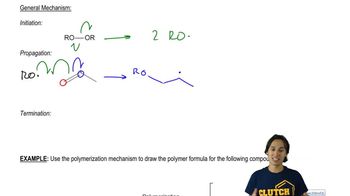
The radical mechanism involves the formation of free radicals during the halogenation process. This mechanism typically consists of three steps: initiation, propagation, and termination. Understanding how radicals are generated and how they react with substrates is essential for predicting the major products of monohalogenation reactions.
Video consigliato:
03:28
The mechanism of Radical Polymerization.
Pratica correlata
Domanda del libro di testo

The radical fluorination of 2-methyl propane resulted in a 14:86 ratio of products.

(a) On the basis of this ratio, calculate the relative reactivity of 1° and 3° C―H bonds in the radical fluorination.

1167
views

Domanda del libro di testo

For each of the following acid–base reactions, (i) predict which side of the reaction you expect to be favored. If a pKa is not one of the ten common ones we learned in Chapter 4, it will be given to you.

(a)

1065
views
Domanda del libro di testo

The radical fluorination of 2-methyl propane resulted in a 14:86 ratio of products.

(b) From the relative reactivity, calculate the difference in energy between the transition states of the first propagation steps leading to a 1° and 3° radical.

1068
views
Domanda del libro di testo

The following table of strain energies is associated with a variety of 1,2-gauche interactions. Use this table to answer the questions (i)–(iv).

For each of the bond rotations shown, (i) identify which you believe to be more stable, (ii) calculate ∆G°, (iii) calculate the equilibrium constant, and (iv) draw the transition state.

(c)

1108
views
Domanda del libro di testo

For each of the following acid–base reactions, (iv) draw the transition state, paying close attention to the degree of bond forming and breaking present in the transition state. If a pKa is not one of the ten common ones we learned in Chapter 4, it will be given to you.

(a)

813
views
Domanda del libro di testo

Predict the major monohalogenation product(s) of the following reactions. Indicate whether you think the reaction will be selective and justify your position.

(a)

1502
views