Ch. 5 - Chemical Reaction Analysis: Thermodynamics and Kinetics
Mullins - Organic Chemistry: A Learner Centered Approach 1st Edition
Mullins1st EditionOrganic Chemistry: A Learner Centered ApproachISBN: 9780137566471Non è quello che usi tu?Cambia libro di testo
Capitolo 4, Problema 52b

Predict the product(s) of the following halogenation reactions. Only one equivalent of the halogen is used in each case. If the reaction proceeds selectively, indicate this by only drawing the major product. If the reaction is not selective, draw all possible products.
(b)

Guida verificata passo dopo passo
1
Step 1: Recognize the type of reaction. This is a halogenation reaction involving chlorine (Cl₂) under heat, which typically proceeds via a free radical mechanism.
Step 2: Identify the structure of the starting compound. The molecule is a cyclopentane ring with a double bond and a methyl group attached to one of the sp² carbons in the double bond.
Step 3: Determine the sites where the halogenation can occur. In this case, the reaction can occur at the allylic position (the carbon adjacent to the double bond) because allylic radicals are stabilized by resonance.
Step 4: Consider the selectivity of the reaction. The allylic position is preferred due to the stability of the allylic radical formed during the reaction. The major product will result from substitution at this position.
Step 5: Draw the major product. The chlorine atom will replace one hydrogen atom at the allylic position, forming a chlorinated compound. If there are multiple allylic positions, resonance structures should be considered to determine all possible products.

Risposta video verificata per un problema simile:

Questa soluzione video è stata consigliata dai nostri tutor come utile per risolvere questo problema.

Concetti chiave

Ecco i concetti essenziali che devi comprendere per rispondere correttamente alla domanda.

Halogenation Reactions

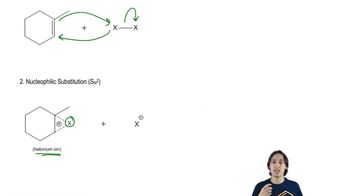
Halogenation refers to the chemical reaction where a halogen atom (such as chlorine or bromine) is introduced into a compound, typically an alkane or alkene. This process can occur through radical mechanisms or electrophilic addition, depending on the substrate and conditions. Understanding the mechanism is crucial for predicting the products formed during the reaction.
Video consigliato:
03:45
Halogenation Mechanism

Selectivity in Reactions

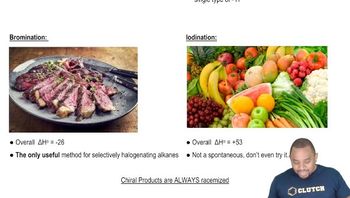
Selectivity in organic reactions refers to the preference of a reaction to produce one major product over others. In halogenation, selectivity can be influenced by factors such as the stability of the intermediates and the nature of the substrate. Recognizing whether a reaction is selective or not helps in accurately predicting the major product or all possible products.
Video consigliato:
10:08
Radical selectivity: Food Analogy

Product Prediction

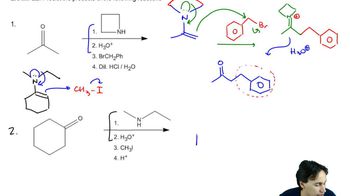
Product prediction involves determining the expected outcomes of a chemical reaction based on the reactants and the reaction conditions. This includes understanding the types of bonds formed or broken, the stability of potential products, and the regioselectivity or stereoselectivity of the reaction. Mastery of this concept is essential for accurately drawing the products of halogenation reactions.
Video consigliato:
03:13
Predict the Products