Ch. 5 - Chemical Reaction Analysis: Thermodynamics and Kinetics
Mullins - Organic Chemistry: A Learner Centered Approach 1st Edition
Mullins1st EditionOrganic Chemistry: A Learner Centered ApproachISBN: 9780137566471Non è quello che usi tu?Cambia libro di testo
Capitolo 4, Problema 17

The combustion of alkanes is exothermic (∆H° < 0) . Would you expect the combustion of butane or cyclobutane to be more exothermic?

Guida verificata passo dopo passo
1
Step 1: Understand the combustion reaction. Combustion of hydrocarbons involves reacting the compound with oxygen (O₂) to produce carbon dioxide (CO₂) and water (H₂O). The reaction releases energy, making it exothermic (∆H° < 0).
Step 2: Compare the molecular structures of butane and cyclobutane. Butane is a straight-chain alkane (C₄H₁₀), while cyclobutane is a cyclic alkane (C₄H₈). Cyclobutane has fewer hydrogen atoms due to the ring structure.
Step 3: Consider the bond energies. Cyclobutane has significant ring strain because its bond angles deviate from the ideal tetrahedral angle (109.5°). Breaking the strained bonds during combustion releases additional energy compared to the combustion of butane.
Step 4: Analyze the stoichiometry of the combustion reactions. Butane (C₄H₁₀) requires more oxygen molecules for complete combustion compared to cyclobutane (C₄H₈), as it has more hydrogen atoms to oxidize into water. Write the balanced equations for both reactions to confirm this: For butane: C₄H₁₀ + 6.5O₂ → 4CO₂ + 5H₂O For cyclobutane: C₄H₈ + 6O₂ → 4CO₂ + 4H₂O.
Step 5: Conclude based on energy release. The combustion of cyclobutane is expected to be more exothermic than butane due to the additional energy released from breaking the strained bonds in the cyclobutane ring. This strain energy contributes to a larger negative ∆H° value for cyclobutane combustion.

Risposta video verificata per un problema simile:

Questa soluzione video è stata consigliata dai nostri tutor come utile per risolvere questo problema.

Concetti chiave

Ecco i concetti essenziali che devi comprendere per rispondere correttamente alla domanda.

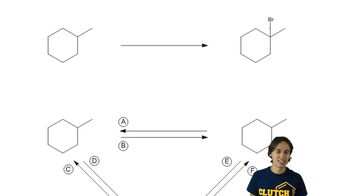
Combustion of Alkanes

Combustion of alkanes refers to the chemical reaction where alkanes react with oxygen to produce carbon dioxide and water, releasing energy in the form of heat. This process is exothermic, meaning it has a negative enthalpy change (∆H° < 0). The efficiency and energy output of combustion can vary based on the structure of the alkane involved.
Video consigliato:
02:47
Functionalizing Alkanes

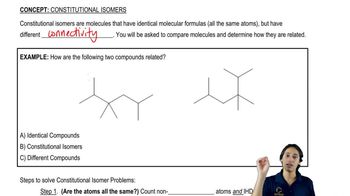
Structural Isomers

Structural isomers are compounds that have the same molecular formula but different structural arrangements of atoms. In this case, butane (a straight-chain alkane) and cyclobutane (a cyclic alkane) are structural isomers. The differences in their structures can influence their stability and the amount of energy released during combustion.
Video consigliato:
01:10
What is a constitutional isomer?

Energy Content and Stability

The energy content of a molecule is influenced by its stability, which is determined by factors such as bond types and molecular structure. Generally, more stable molecules release more energy upon combustion. In comparing butane and cyclobutane, the cyclic structure of cyclobutane may lead to different combustion characteristics, affecting the overall exothermic nature of the reaction.
Video consigliato:
03:43
The radical stability trend.